Revealing the Mysteries of the Tinctures of the Seven Metals
Study the Art with Us Buy me Coffeehttps://www.alchemy-texts.com/book/revealing-the-mysteries-of-the-tinctures-of-the-seven-metals/
Revealing the Mysteries of the Tinctures of the Seven Metals
By Basil Valentine
(Editions de Psyché, Paris, 1954)
Introduction by André Savoret
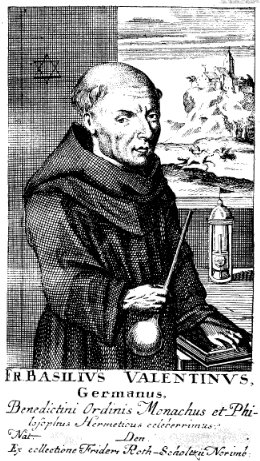
The text given here is that of the French edition of 1646. It has been followed as closely as possible, rejuvenating only the spelling and certain obsolete expressions. The & sign for " and " had to be kept. By its superabundant use, it often plays the role of simple punctuation; in other cases, it would have had to be rendered by multiple prepositions from which we preferred to abstain. Moreover, a text of this order is not an exercise in style.
One could call this REVELATION the "Key" of the author's "Twelve Keys". Not only does this one, - one of the Princes of Hermetic Philosophy, - treat there, as he modestly promises, of the "Medicinal Virtues of the Tinctures of the Seven Metals", but he exposes there, with all the clarity permitted by adept discipline, some of the most secret points of the Doctrine and Practice. Insofar as I have been able to grasp the most precious indications of the famous Adept, and without seeking to comment on what carries in itself his own commentary, I will point out to the studious reader the content of pages 29 and 30, as well as that of pages 72 and 73 (not to mention others), which are to be read, re-read, and weighed by carat.
In an analogous order of ideas, we can draw the most valuable lessons from the figure by which Jacques de Senlecque condenses the two methods of the Work and leaves the Agent to be presumed. On this engraving, Eugène Canseliet (pp.116-117, from "Deux Logis Alchimies") said, I believe, all that could be said openly, with the most luminous concision.
If I may be allowed to close this Introduction with one piece of advice, I will content myself with developing the one that Basile Valentin himself gives on the way to read it: Explain his writings SIMPLY and WISELY because they carry within them their sentence and conclusion . .
Indeed, our hermetist, particularly in this booklet, is more loyal and direct than a Philalethes or a Trevisan. This does not mean that it should be approached without precautions. If the excess of credulity or ignorance is an obvious obstacle to the understanding of his text, too great a subtlety can also lead to hearing it outside of his subject, either that we transpose abstractions in laboratory terms, or that one takes, conversely, very concrete manipulations, for transcendent allegories. Here, as in many other areas, the student should aim to unite the simplicity of the Dove with the prudence of the Serpent, as the supreme Initiator recommends to us.