Treatise on the nature of the philosophers' egg
Listen Audio Book Study the Art with Us Buy me Coffeehttps://www.alchemy-texts.com/book/treatise-on-the-nature-of-the-philosophers-egg/
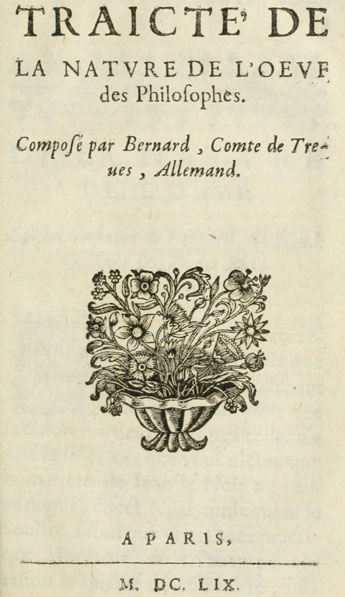
Treatise on the Nature of the Philosophers’ Egg, composed by Bernard, Count of Treves, a German.
ON THE NATURE OF THE EGG.
A certain Letter of Bernard the German concerning the Philosophers’ Egg.
1. Newest Translation
2. French Transcription
3. Older Translation
Sir, with due correction, it seems to me that, concerning these matters, you desire something different from what the definition of natural things has handed down, when you say that the matter of Jean le Noir cannot be brought to effect, and consequently neither can the Sulphur, according to the manner in which you have practised it.
Sir, you have not understood the quality of this Sulphur according to the essence and alteration of the matter. Indeed, the perfective matter of the aforesaid Jean le Noir must be brought to its end by natural preparations; but you propose many things which are of no service to the purpose, and, in an unworthy and confused manner, you have not understood the possibility of Nature.
The sound of the words has deceived you. For it was necessary first to discern prudently what must be done first, and why, and when; because that which is first, being last in resolution, is first in imposition. For by this means you must arrive at the knowledge of the Sun and of the Elixir; that is to say, by reducing this thing to its first principles and Elements, from which it is made.
You must therefore divide the compound until you reach the uncompounded things. But first it is necessary to possess knowledge of the compound, and then to reduce it into ordered parts until you arrive at its principles.
This is resolutive knowledge, while the doctrine called compositive is that which joins together what it has divided, beginning from the first matter and from the principles and Elements which are found in compounds. Resolutive doctrine, on the contrary, begins with compounds and proceeds to simple things and to the principles and Elements which are called the first matter, from which is made the Elixir that transmutes bodies.
How, then, do you believe that you can introduce the form of the complete Elixir into matter which is less disposed toward it, seeing that the Elixir must be capable of being made from things homogeneous and uniform in substance, as from pure Mercury, in which the entire substance of the fixed body remains dissolved and rendered volatile without any separation?
Now the intention of the Philosophers always has been, is, and will be, to make spirit out of body; that is to say, pure Mercury, which is called philosophical, because it is made by a philosophical procedure and contains within itself a double nature.
Since, therefore, the Stone must be composed of two substances, the volatile and the fixed, it is first necessary to make, or extract from the union of these two, their Mercury before making the complete Elixir.
And this is their Mercury, which causes perfection and in which the entire Magistery consists.
It is this Mercury that they meant when they said:
If you can complete your work by Mercury alone, you will be a very skilful investigator of the Art.
This is accomplished through the suffering which it must undergo, being hidden and homogeneous with its body.
And this is the Mercury which they commanded first to be chosen, derived equally from bodies and from Mercury not that it is Mercury in its entire nature, as commonly understood, nor in all its substance; for it has already lost all its earthly and combustible dregs, together with much of the dissipation of its fugitive aqueousness, and there remains a pure substance, half united and conjoined with the fixed substance.
For in the Work, before the true transmutative Medicine of the Stones can be made, it is necessary to sublime the whole not merely the volatile part, but also the fixed.
Then, when the whole has been converted into spirit, the Philosophers called it the water of volatility. Indeed, before this consideration, whereby the entire matter is converted into smoke, they called the whole Stone water, as Socrates testifies in the Turba, saying:
If you do not reduce the whole into water, you will not attain the Work.
For the body must be occupied by the flame of the fire so that it may be destroyed and rendered weak with the water in which it exists.
And Consolies says:
Know, O Investigators of this Art, that every body is dissolved with the spirit with which it is mingled, and with which, without doubt, it is made spiritual.
Now when this spirit is sublimed, it is called water, as was said before; and this water washes and cleanses itself.
For the entire substance, being exceedingly subtle, as has been said, rises upward, leaving behind that which corrupted it.
[Handwritten note at bottom:]
There appears to be a printing error. One should read [unit, “unites”] instead of putrifie, and above one should read estant instead of est.
For Mercury [printed: “putrefies”; handwritten correction: “unites”] in the Work, through which the body is converted into spirit, not only from its sulphurities, but also from all earthiness and from the gross and subtle aqueous parts arising from viscosity, attached by strong mixture; and thus is made the Mercury of the Philosophers, of which Geber speaks.
The consideration of the perfecting thing is the pure substance of Mercury, because in the elevation both the one and the other rise in the form of smoke through a preceding fusion.
And because at that time it also melts and is coagulated by cold, and strips itself of superfluity, it washes itself and imbibes itself with its own water; that is to say, with the prepared spirit which came from the same seed.
This is the Philosophical dissolution, which is accomplished by means of the dissolving fire, first prepared as required, made and invigorated.
The Philosopher Mirandus testifies to this, saying:
The body must be liquefied with its dissolvent in order that it may be altered from its corporeal nature, until through destructive dissolution the body is made spiritual and subtle.
Now because this Mercury contains within itself a fixative nature which is conjoined with it, and likewise because of its double nature, the Philosophers have called it permanent water, enduring in the fire.
For the volatile part does not exist without its body, with which it is dissolubly mingled, and the two are made inseparably one.
Yet this [volatile part] is not naturally, or by its own nature, permanent in the fire. Therefore one must not trust in sublimed Mercury, nor even in dissolved Mercury, since the whole is fugitive, but rather in that which has been calcined after dissolution.
Thus says the expositor in the Lumière des lumières [Light of Lights]:
When sublimed, it flees from the fire and is white by nature; but when it is coagulated and calcined by its coagulant, it is fixed and retained.
And this coagulant is the body hidden within the Mercury of the Philosophers.
When it comes to birth, this Mercury is called milk, because it fixes and coagulates through its hidden body and is made one with Mercury, one in substance.
Thus it coagulates itself and not some other thing.
This is recognized from melted wax, because in the commixture they become entirely one without separation, so as to endure eternally; and each, in its own substance, completes the remainder.
That which is placed in the fire passes from nature into nature until, in the same vessel and in the form of matter, it is converted into the true Medicine.
And this is its final disposition, which greatly resembles human generation.
Now your matter has not yet attained that property by which it can be called the Philosophical Egg, nor that disposition by which it may ultimately be transformed into the complete Elixir, as an egg is transformed into a chicken.
For your entire matter has not been wholly brought into a rounded spirit, circulated by the proper circulation; rather, there is a body which of itself is fixed and does not flee, and a fugitive spirit which of itself exists without the fixed.
From this it is evident that this is not an Egg, since the one rejects the other.
Since, therefore, the generation of the Great Elixir takes place vaporously and by commixture in the air, how do you believe you can arrive at the end from enemies that are too distant from one another in nature?
For the body, when it allows the spirit to separate from it without its nature, and the spirit, when it rises without its fixity, can never be converted into Elixirs, because vaporously they cannot mingle with one another.
The reason why the Philosophers called their Mercury an Egg is also this:
Just as an egg is a round, circular thing containing within itself two natures in one substance, the white and the yolk, and draws from itself another thing possessing soul, life, and generation namely when a chicken comes forth from it so likewise here Mercury contains within itself two things of one nature, body and spirit, and draws from itself soul and life when the whole has become spiritual.
From this afterwards arises the generation of the true Elixir.
This caused Mirandus to say:
This Egg draws from itself the life which it possesses, and afterwards the soul and generation.
And Plato said:
In the Egg of the Philosophers there are things which, being thoroughly mingled and putrefied, are converted into spirit, for it is living and not dead.
This, therefore, is the Egg which, being placed upon the fire through simple decoction, without being touched by the hands, produces a chicken by one single disposition, completing and perfecting itself.
And this is of an hermaphroditic nature, because it is, as it were, male and female, and of an hermaphroditic complexion.
The Philosopher confirms the same, saying that the seed of the plant is likewise comparable to impregnation, which is a mixture of male and female.
And just as within an egg there is a power for generating a chicken, together with the matter necessary for it until it comes forth from the egg, so likewise it is in ours.
And just as the female lays an egg in a single hour, and likewise [produces] the seed of the plant, so also do we [make] our Egg, so that an Elixir may be generated from it.
From this it is easy to see that an Elixir cannot be generated except from things which possess within themselves an Hermaphroditic complexion, as is seen in the aforesaid Egg.
Now Albertus attempts to confirm the complexion of this Egg in the third book De mineralibus, saying in the chapter on Sulphur:
It is necessary that the hot and dry be joined to the moist and cold in one and the same complexion, and this complexion is Hermaphroditic.
As is seen in plants.
I write to you this determination concerning the Egg, together with its explanation, for fear that you should err concerning the proximate matter from which a perfect Elixir must be made.
For a certain man of Carcassonne, calling himself Maistre Tolquet, assured Leotard that he had seen your matter in a certain vessel in the form of Mercury mingled with the body, and as though half coagulated.
He said of it, as a reproach, that it was not an Egg.
Although he speaks the truth in saying that you have gone astray, nevertheless, in reproving you, he gives his opinion without knowledge of the cause with all due respect to him and to those who follow him.
I have understood his intention from his sublimation and from the water which he believes he can extract from it, and which, with great ignorance, he declares to be the Philosophical vinegar.
But in truth, since Nature and all his hope contradict him, his words contain no truth.
He is far removed and alienated from Philosophy by superfluous fantasies, considering neither the forms of this transmutation, nor the Elements, nor that which is real, but rather that which is fantastic.
Nor does he consider that these same forms can have their transmutative being from Philosophical matter and from those things which are in Philosophical matter, and not from foreign things.
The true Philosopher must consider that whatever is in the matter is there solely by its nature and is real.
Likewise he must consider motion as the efficient [cause], according as it moves the matter; form according to the being which it possesses in the matter; and likewise the end according to that which is the limit of the motion, according as the matter is moved toward it.
Similarly, the matter itself must be considered insofar as it is capable of being the matter of the Philosophical form, and according as it is the subject of the form, and according to the being which the form possesses in the matter.
In this way one recognizes the manner of working of philosophical men.
But Tolquetus was not a man of such consideration, nor did he alter his complexion.
Although fraternal correction is a work of corporal mercy, because through corporal mercy a man gains mercy for the body, spiritual correction gains the life of the soul.
Nevertheless, when it is of no use to the obstinate, those who resist such correction make themselves demons, not recognizing their defect or fault.
Therefore such people must be left as publicans, according to the judgment of our Saviour.
Math. 18.
Those who fall through ignorance are less removed from the truth than Monsieur Turquet, although you yourself are ignorant of the terms of the Art and of the form of the proximate matter for the generation of the Elixirs or Medicine.
Nevertheless, you possess matter suitable for this purpose and the proper order, provided that you correctly understand the form of the preparations which I have sufficiently given you, together with their qualities and necessary causes and the manner in which they are made.
And because the property of the Work whereby Nature is led and drawn toward perfection is contained within its own matter, through the proper motion of Nature itself, rejoice; for you will be able to discover it, not through doctrine, but through the proper inclination of Nature itself according to its determined motion.
Therefore one must consider motion according as the matter moves toward form.
By this relationship you can regulate the matter by a natural motion, because such a motion, being proper and determined, always tends toward introducing its proper species into its proper matter.
From this necessarily follows multiplication through a similar species in the same matter.
Now since the virtue of the Elixir is generated formatively from the property of the matter either the matter being acted upon by the unctuous moist, or the moist matter by terrestrial dryness, which amounts to the same thing you must observe that such a suffering or combat precedes the transmutation of the substance into the form of the complete Elixir.
That is to say, the dry and the moist must first endure together, because both together arrive at one thing which is homogeneous and naturally generative, without ever separating again, as you can see from the nature and complexion described above.
Now the Egg, considered in its great quantity, is nothing other than an aqueous moisture enduring and suffering beneath the terrestrial dry.
Likewise, the perfect Elixir is nothing other than Mercury which has endured a very great heat and complexionally dry condition.
Therefore the Mercury which has thus suffered will be the proximate matter of the Elixir.
Experience shows that it is not so unless it liquefies and dissolves under strong ignition; and, having thus been united, it coagulates in the cold into a fusible metallic stone.
It therefore appears that Mercury is the proximate matter of the Elixir through the suffering which it receives from the burnt terrestrial dry.
For a fuller explanation, replying to your verses, know that the penultimate term of the Work understood generally throughout all the degrees which we shall attempt to attain is purity of matter and perfect rectitude.
Through these, namely purity and rectitude, our Egg becomes perfect, because then simple Nature rejoices and completes itself in simple and pure Nature, in homogeneity and proportion of the Elements.
Now the reason which has caused some persons to think the composition of this Egg impossible has been either the exceedingly strong construction of the body or the difficulty of its resolution.
For that which is constructed with difficulty is likewise dissolved with difficulty.
But if they understood the natural composition, they would also understand the resolution and how the artificial construction can be accomplished, though by a natural course.
Because they are ignorant of this, they ought to condemn their improper operations by which, through corruption and generation, they attempt to attain another thing.
Such people have discovered that the body is of an exceedingly strong composition, but they do not yet know how strong it is.
For if they had arrived at this point, they would know how the Egg is made from the corruption of the body.
This is why such persons have not correctly understood the foundations of Nature: rejecting the superfluous and increasing that which is deficient.
They understand neither the superfluity itself nor the deficiency, whether concealed or visible; consequently they do not know Nature itself, which is the root and perfect essence, nor the suitability of the Work.
The property of the Work is to conceal that which is manifest and to manifest that which is hidden.
They may recognize this through mortifying and vivifying.
From these things one sees both the corruption and infection of metals and likewise the proper composition of our Egg.
Therefore note that when the Philosophers say that there is nothing superfluous in this Egg, they mean that nothing must be handled and removed from it by the hands, but that everything must be left to the sole decoction of its pallification.
This appears in the decoction of an egg when it becomes hard, or in its ageing; this must be carefully noted.
And afterwards, when they say that there is no deficiency in the aforesaid Egg, they thereby demonstrate that nothing need be added to it, since it contains everything required for our Magistery.
Therefore this Stone is a perfect Egg of two substances of one nature, namely body and spirit, made into unity of essence or nature.
And in this conjunction of resurrection, the body is made spirit like the spirit itself, and they are made as one, like water mixed with water, which can never again be separated.
There is no diversity among them, namely among the three which are:
spirit, soul, and body,
without any separation.
This is truly seen in the unity of the Trinity, in God the Father, the Son, and the Holy Spirit, who are one in God Himself, with distinction but without diversity of substance.
From these words we can directly conclude that the ancient Philosophers who possessed this part [of the Art] were diviners, through this divine Art, of the manifestation of God in human nature or flesh; namely Christ, and His unity with God through the abundance of the Holy Spirit.
Although they understood this only very indistinctly and confusedly, I am of the opinion that the truth and figures of these things should be observed in their writings.
For all those who have been true artists of this divine and glorious Art have been able to establish in God Trinity and Unity Trinity with distinction, but without diversity in Him.
And in this Stone likewise a Trinity in Unity is assigned, and conversely, with distinction but without diversity.
I do not see, for anyone who examines closely and understands, any example in the whole world more similar than this one for demonstrating the Trinity in God.
To this relates what is found in St Augustine, in the first book concerning the Trinity and the soul: namely that within the soul there are these three which nevertheless are one:
memory, intelligence, and love or will.
This is the most beautiful and truthful [comparison].
Perhaps some contradiction might arise elsewhere, but not in this place.
I firmly believe that if some unbeliever properly understood this Art, he would afterwards necessarily become faithful to the Trinity of God and place his trust in our Lord Jesus Christ, Son of God.
If he did not do so, I believe it could only arise from a fear which he possesses concerning his sect and concerning the first law given by others, lest he should be punished in some similar manner.
For through this most hidden and most precious Stone he sees the Trinity in God, just as Hermes, Plato, and the other ancient Philosophers saw it.
There is therefore no comparable thing, nor any investigation, subtlety, usefulness, or treasure equal to this one.
For the soul and body of him who understands these things are made free in this world while awaiting the blessedness of the world to come, so that through good works they may be carried to God after death, and be joined again to their Creator on the Last Day and be eternally happy with Him.
To return to the usefulness of the Stone, we shall say that the spirit and the body will never attain the aforesaid union, as Raso testifies in the encomium of his book, until both have been cleansed.
He also says, so that you may better understand it, that these preceding terms and dispositions agree greatly with that which is generated in the Egg before those dispositions are accomplished by which it can be converted into the complete Elixir.
Know that the aforesaid things, namely spirit and body, do not properly unite with one another so as to demonstrate their virtues through which the perfect operation is accomplished unless both are thoroughly clean.
For the body will not receive the spirit, nor the spirit the body, so as to make the spiritual corporeal and the corporeal spiritual, unless all filth and impurity have first been removed.
Once this has been done, the body embraces the spirit and the spirit the body, and from them the perfect operation is produced.
If fixation overcomes the great volatility, [the Egg succeeds]; but if the exceedingly great fixation is overcome by the great volatility, the form of the Egg is not completed, there being only a body which withdraws toward the spirit.
And here lies the penultimate term of our Mercury, which is called Egg, containing within itself everything required for the perfection of our Magistery.
There is nothing superfluous in it, nor any deficiency in the perfection of the Egg; rather it contains everything necessary for producing the chicken and the Medicine.
From this, an artist of sound understanding may observe that in this Magistery there are three things which demonstrate the order:
First, preparation precedes conjunction.
Second, the preparation of each of the two is not itself perfection, but only a disposition toward conjunction, through which it assumes the form of Stone, or Sulphur, or our Mercury, which are only one thing in the Egg concerning which we have treated above.
Conversely, perfection is not simply preparation, but an immediate induction of form capable of completing our Work.
Third, throughout the entire time of their conjunction, when their union has been perfected, they are forever found pure and clean and stripped of every superfluity.
From this it can easily be seen that at the time of their purity both are gradually made ready for the rectitude of the Stone, or generation of our Egg, and neither before nor beyond that point.
Now it is sufficient properly to prepare the matter so that it is purified not only from every combustible superfluity, but likewise from all earthiness, both gross and subtle, attached by strong mixture to the aqueous parts arising from viscosity.
This purification is accomplished when the body becomes spirit and the spirit becomes body.
For during the procedure of the Work there occurs conversion until very ready Nature has found a permanent state in which it terminates its motion.
This is the form of the generation of the Egg.
Then Nature begins another motion for forming the perfect Medicine, once again corrupting our Egg from its form and introducing into it another form, that of the perfect Medicine.
And this is what is meant by passing from degree to degree.
But the wisdom of a good Artist must diligently inquire into the reason why the purified Stone is completed by solution, and why it does not come sooner and more surely to its intended end.
Since opposite causes produce opposite effects, and since through one contrary the other is known, it should be observed that the proximate cause through which the purified Stone is perfected by solution is an exceedingly great similarity of one to the other:
of spirit to body,
and of body to spirit,
not merely in matter but also in complexion, qualities, and natural properties.
For the more closely the body approaches the complexion of the spirit, and conversely, the more quickly they become one and are transfigured into the Egg.
For each thing desires that which most closely approaches its own complexion.
And because the body is exceedingly hot in the depth of its nature, the hotter and purer Mercury is, the more penetrating it becomes; it melts better and unites better with the body, so that from two complexions there arises a single complexion compounded in its simplicity.
For that which is hot is digestive and in a certain manner resembles resolved heat and moisture.
The colder it is, lacking acute heat, the less deeply it penetrates the body and the more slowly it dissolves it.
Consequently it also joins with it more slowly, partly because of the matter and partly because of the quantity and quality of that matter.
The species do not separate from the species, but [the difference arises] because of the subsequent form.
Therefore the Artist must completely understand the matter of Nature, its quantity and quality, since the aforesaid things are without doubt known to him alone.
Now the proper instruments of Nature through which she acts mediately upon matter for the introduction of the form of the Egg are unknown.
For no agent, whether natural or artificial, can act without its proper and determined instruments.
You see this because Nature, in the generation of all things, acts by means of digesting, altering, and cleansing heat as by her proper instrument, according as the nature of each thing requires.
How, therefore, if you are ignorant of this instrument, do you believe that you can form an Egg?
You cannot.
Art indeed takes the impure spirits of Nature and joins them with the pure and spiritual things of Nature; and by subliming them, raises and cleanses them as Nature does, stripping them of all evil sulphurity.
And in this stripping, Nature acting and operating therein equalizes the qualities of the Elements and their proportions in the mixture.
Although we do not know these proportions, it is neither necessary nor within our power to know them, nor do we desire to know them, because this is known to Nature alone.
For Nature rectifies herself, cooking her Elements and bringing them into the proportion of her species.
This is the rectitude of Nature and consists in the equality of her Elements and their proportions.
Since Art cannot itself equalize the Elements which are in Nature for it belongs properly to Nature to bring the Elements to their proportion it follows that it is sufficient for Art to understand and work with Nature, assisting Nature, so that Art itself may in turn be assisted by her.
Thus Art works with Nature, and Nature with Art, in the transmutation of the nature of metals.
When, therefore, the spirits have been cleansed through sublimations and then wish to flee from the fire, Art, seeing them as orphans, immediately administers to them a pure fixed nature so that they may be strengthened by it.
The elemental and celestial virtues of the spirits which are in them are thereby directed toward the intention of that same Nature.
Thus Nature, and not Art, converts them into clean and fixed bodies, Art serving merely as an organ or instrument.
In this way the nature of bodies shall always dominate the nature of spirits.
Through this miraculous industry, Art imitates Nature, hastening and accelerating her works.
But because Art behaves in this manner with Nature concerning the sufferings involved in the operation and generation of the Stone, there are found excess, a mean, and deficiency.
Therefore the Philosophers command that the weights of the one and the other be known, seeking the proportion among the virtues of the best.
For the property of Art, when it nourishes its Stone, strives to observe four points in its upbringing, namely:
how, when sooner, when it is required, and how much is required, and in what manner it must be done.
These terms apply no less to actions and sufferings if one considers the weakening or strengthening of Nature with which Art operates.
Through the dispositions of Art, the intrinsic things are governed.
For this reason the Philosophers have specified with measure the natures of the fires in the Magistery of decoction, considering the middle nature.
For such a virtue, considered in itself, is a certain mean and conjectural measure thereof, because it regards the mean and the mean performs the operation.
Furthermore, because an operative disposition is presupposed for the rectitude of Nature, washing [the matters] in the stripping away of corrupting Sulphur, you must dispose your matter so that it may melt; otherwise it will neither be cleansed nor rectified and consequently cannot assume the form of an Egg.
For this reason Arnault de Villeneufue says in his Nouveau Testament [New Testament] that the Stone must first be known as to what genus it belongs; and once this is known, it must be cleansed by removals and fusions.
But before the matter takes fusion, it first putrefies, since it contains the substance of liquefaction.
It cannot in any way be drawn forth by another operation.
Therefore the aforesaid Arnault says in his Rosaire [Rosary]:
If it is not putrid, it cannot be melted and will not be dissolved.
And Morien says:
Know that after putrefaction one obtains Azoth, which is interpreted “substance of liquefaction,” through which the Most High God and benign Creator created the great [work] and completed the composition which had been sought.
But it will not attain true putrefaction until it has first been divided into elementary substances, because within these are found the putrefactive virtues which are called the principles of all transmutable bodies, or of generative and corruptible things.
For all things receive from the qualities of the Elements diverse alteration tending toward generation, mediately or immediately, more slowly or more remotely according to the strength or weakness of the putrefactive, corrupting, and generative virtue.
Therefore your industry must seek this Art in the Elements of the permanent Stone.
For, as Arnault de Villeneufue says:
Our science consists in the science of the four Elements and in their equal conversion.
For everything which exists in the world exists in them, not visibly, but by virtue.
And because their separation is necessary, he adds that these same Elements, through distillation and putrefaction, shall be reiterated and conjoined.
For by this means the whole body becomes spiritual and [returns to] the first matter from which it was originally made, and from the four Elements.
Although afterwards, in the operation of the Work, there is made another first matter through their proper conjunction, very proximate to the metallic genus.
From this it appears that what we understand concerning the nature of the Stone proceeds from its Elements.
Therefore you must know the:
first matter,
the proximate matter,
and the most proximate matter.
For all the Philosophers have held this preparation to be true and that nothing is known except through its principles.
Proof of this is seen in the second book of the Physics, that understanding, sensing, or judging in all sciences comes only through their principles, causes, and Elements.
But because the virtue of the matter must be proportioned to the powers according to the being by which it is perfected in act, you must arrange its operation according to that form toward which it must first be disposed or brought near.
For form enters every kind of matter which is disposed and approaches it.
And since there are as many degrees of matters as there are orders of forms according to Nature, consider by what form and to what degree you intend to sublime our matter.
Accordingly, first dispose it through its proper operation, so that it may be rendered suitable to receive the aforesaid form through which it must be perfected and sublimed.
Now this aptitude or approximation to the first [form] is first conceived through its proper and natural operation, for there is perfection within it according to its degree, as I remember from what was said above.
For the matter, although it has been sufficiently prepared through the preparation of the first or second degree, cannot receive form unless you join to it the preparations of the third degree, which dispose the first.
Although through the preparations of the second degree of sublime perfection it has been made very near to conceiving the form of the third, one cannot pass from one extreme to another except through a middle.
For just as the operations dispose the matter toward the form of the first degree, so [they lead] to the effects and operations through which it acquires the form of the second degree.
And thus through operations they render it capable or dispose it so that it assumes the form of the third degree and of the Great Elixir.
When, therefore, it is in the third degree, it is the Great Elixir.
And when you wish to possess the form of the third degree together with that of the second while lacking that of the first degree, labour as much as you wish to bring that matter near to such a degree and to the greatest degree you labour in vain, thinking that you can give it the final form of the Elixir.
For I cannot write to you everything that is necessary, leaving those things to your judgment.
The spiritual things declare sufficiently how you must regulate your Work through the degrees of forms and, according to the nature of each degree, prepare the matter of Nature, so that through the preparation of one it may be disposed toward the preparation of the other, until you arrive at the end of your desire by following its degrees.
For you would not wish to allow your Work so little time as many fools believe, because this is contrary to reason and contrary to the motion of Nature.
Believe the warnings of the Philosophers who have seen the depths of Nature.
For Hippocrates says:
Time is short because of the age; experience is long because of time.
Concerning which Geber says that few, and principally among the ancients, possessed this science.
He said ancients, and not young men, because young men are impatient and wish to possess it in a short time.
Therefore he concludes, in the book entitled De l’investigation du parfait magistère [On the Investigation of the Perfect Magistery], not that the time is short, for elsewhere he says:
This is the Medicine which has occupied a very long time, or which anticipates the span of a very long time.
And in the Somme, in the chapter concerning the Medicine of the third degree, he says that because of the greater industry required in administering this matter and perfecting its preparation, a long time is required for the accomplishment of truth.
Although the Medicine of this third degree is not different from the Medicine of the second order except in its creation through other exceedingly subtle degrees of sublimative preparation and through long labour.
And elsewhere, concerning Mercurial coagulation, he says that it is exceedingly difficult to coagulate the fiery humidity, which is accomplished by the Artist only with exceedingly great labour and profound industry.
All these things signify a long time.
Therefore the Philosophers also exhort us to patience in delay.
Let the impatient man therefore abandon the Work, because every action possesses its determined motion and time.
And Master Arnault de Villeneufue says in his Rosaire:
Our Medicine must remain accustomed to the fire longer than the child which is nourished.
Here it should be observed that “longer” means more than merely “long,” which nevertheless is already more than “short.”
The Medicine therefore is not made in a few days, nor in a few months, nor in a short period, because it must be subdued for a longer time by fire and nourished therein.
This is said because of the mutations which constitute the best and principal part of the operation and require exceedingly long labour.
This is seen in the nature of Mercury through the exhalation of the exceedingly subtle parts and through preservation of the moisture of the grosser parts.
This is accomplished through repeated sublimation until it becomes the Great and Perfect Elixir.
For our Mercury is of a viscous and subtle substance, as experience demonstrates when it is beaten together with the imbibition and mixture which it possesses.
In these it demonstrates its viscosity because of the great adherence of its parts.
Through consideration of its weight its density is observed.
And because of its exceedingly strong composition, [its preparation] cannot be accomplished except through a long space of time and great industry, as experience likewise teaches.
This same cause of congelation or inspissation of the Moon, which is perfected through repeated sublimation, together with the difficulty of handling it, seemed worthy of being mentioned.
For it is found to be of the same nature as bodies, since through decoction all bodies take their origin from it, and it can be extracted from all bodies through a certain reincrudation.
From this one sees that the mutations of this labour are exceedingly long and that its handling is of equally great difficulty, especially in subliming it by making a great fire.
Although the Philosophers divide their Magistery into many operations according to the degrees of forms and their diversities, nevertheless there is only one operation in the formation of the Egg.
But through the repetition of its action, diversity continually arises in the motion, in the colours, in their slower separation, and in the strengthening of the fire.
Such diversity in the Work produces diverse operations, although in truth there is only one single operation and one manner of working.
Thus the Philosopher expressly says in his book where he explains the figure of the Hunt of the Lion, agreeing with the intention of Morien, who says that the Magistery is nothing other than:
an extraction of water from the earth, and a mingling of water upon the earth, until the earth putrefies and is cleansed, so that afterwards it may dissolve and become entirely spiritual together with the spirit.
And this is then called the Egg and the Mercury of the Philosophers.
For this reason Morien adds:
When it has been cleansed with the help of God, the entire Magistery will have been accomplished.
For he means that the body is dissolved into spirit.
And this is the solution which you alleged above, which takes place immediately after its complete purification from every corrupting thing.
For such purification is accomplished only through the virtue of putrefaction, which is nothing other than a great heat of spirit.
This corrupts the body through a foreign complexion and putrefies it, penetrating to its deepest part without the two ever being capable of separation.
Thus through such putrefaction and elixation, the body is reduced to the complexion of Mercury, which is different from that of the body.
And in order that you may understand the nature of the corrupting and putrefying agent, it must be observed that whatever is in the dissolving and putrefying Mercury must necessarily exceed in strength the heat of the Work in the complexion of that body.
And when this heat, which is the complexion of the body itself, [is overcome], because the other heat is foreign to its complexion, it corrupts its complexion and converts it into an Egg that is to say, into hot and moist Mercury, as the victor.
Thus that which in the beginning was dry and fixed is made spiritual and flying; and that which first existed in metallic form assumes the form of Mercury.
But such Mercury is not found upon the earth except that which is contained within the perfect body, from which it is extracted through putrefaction by means of the heat of a foreign complexion.
This is apparent from its definition, which is defined by famous authors in this manner:
Putrefaction is the corruption of the proper humidity which is in the Mercury contained within the body, through foreign heat.
Furthermore, it is proper that Mercury should putrefy and should neither resolve nor consume the moisture of the metal, but rather, remaining within it, should corrupt it through natural qualities which dispose it so that it becomes a contrary metal.
It therefore changes the complexion appropriate to the metal into another complexion.
It could never accomplish this while the moisture of the metal, informed by its natural heat, remained therein.
Therefore the heat of the spirit together with the aqueous [nature] must first, like a Scorpion, corrupt by its sting the natural heat of that same body.
And because the bearer of the heat or Sulphur is spirit that is to say, Mercury, which holds Sulphur bound together with itself for the complexion of the body it is therefore necessary that our Mercury first corrupt its complexion.
For demonstration of these things, on account of my very dear Jean, bearer of the present letter, and of this most hidden science or Art, I shall reserve for you, as far as possible, still greater secrets, trusting that you will forever be an observer of secrets, concealing them as though beneath the filth of dung.
I therefore say that in all putrefying agents there must be a foreign heat which corrupts the proper natural heat.
Now I call this natural heat that which is proper to all metals and through which they receive their complexion or rather that Sulphur, which is the same thing, from which they receive their congelation according to their species, and which is found in their complexion in metallic form.
But the foreign heat is called that Sulphur which has been complexionated and brought to the complexion of our corrupting and putrefying dung, which is interpreted as:
hot and moist Mercury of dung.
Although its complexion is natural and proper to itself, it is nevertheless foreign to that of the Sun or Moon.
Yet it can be brought into equality with the complexion of the Elixir of the Sun or Moon through ferments, acting as a foreign heat dominating the complexion.
For the complexion of our heat of dung and Mercury abounds in humidity, whereas the complexion of the Sun and Moon, considered in relation to the dung, abounds in dryness.
Therefore, when the heat of the dung is joined with that of the Sun or Moon, it begins to act upon it through its humidity, corrupting the natural heat of the Sun or Moon, and consequently its entire complexion, through its more prolonged heat.
That which was first coagulated in the form of Sulphur within the species of Sun or Moon is thereby transformed completely into a very liquid substance of Mercury, transmuting whatever it touches, as has been said provided that the powers of the dung are stronger than the heat of the Sun or Moon.
For the Sun or Moon cannot putrefy while it remains informed by its natural heat.
Therefore the heat of the Sulphur of the dung must be more powerful in acting upon and corrupting the natural liquefactive moisture of the Sun or Moon.
For one thing cannot corrupt another unless it excites it, whether it be of the same moist and hot genus, as air and fire, or completely contrary, as hot and cold, water and fire.
This is also the reason why all things existing in a certain motion undergo corruption.
For natural things possess contrariety; some overcome this contrariety, while others are entirely contrary.
And because some of them prevail in virtue, they continually act upon one another and continually suffer within one another.
This is the reason why the life of animals is commonly shortened and their duration continually tends toward corruption.
Thus among animated things there is no faculty by which they can remain and live forever.
And it is because the heat of the Sulphur of the Sun or Moon, being overcome, receives contrariety from the heat of the Sulphur of dung.
From this the substance putrefies and corrupts and is converted into the very nature of dung, as into a natural putrefaction.
Our dung therefore changes the complexion of the metal into that of an Egg and into liquid Mercury, possessing qualities disposed toward conversion into Sun or Moon.
This could never occur unless it were first dissolved through complexionated moist heat.
Dissolve it, therefore, embracing it with the Nature and heat of dung, and with that Mercury which the Philosophers in their secrets have called dung.
For its natural moisture, by reason of its fatness, is preserved for a longer time through putrefaction in its proper heat.
Therefore it generates putrefaction in the metal, within which such moisture remains for a long time.
And because it is preserved longer, it dries with greater difficulty and separates more slowly from the dissolved substance.
This is seen in its fusion.
For this moisture is radical to metals of the moist genus, just as dung is radical to other things according to Nature.
This is seen here because it is joined to them even to the root and possesses admirable, indeed infinite operations, which the Philosophers have concealed under horse dung and other contemptible things, as also under salts, alums, and sharp substances.
But however this may be, I say concerning its nature that earth and water belong chiefly to the class of passive material things.
Both are cold.
Cold cannot coagulate or thicken except by assisting and constricting the parts of the matter, and not by introducing into it a substantial form, as complexionated heat does.
Therefore a foreign heat must be introduced into them.
This happens, for example, in the water of ferment, which is essentially cold but hot to the touch.
Likewise, water strained through ashes is hot because it possesses heat operating within it through the ashes.
This heat exists in ashes as in other things that have been subjected to fire, in which fire has operated for a long time.
Thus through heat there is more or less hotness according to the diversity of the operation of heat within it.
For this reason also the Sun, Moon, and Mercury are generated in putrefactive places, because the natural heat of evaporation is present there, which gives body to the moisture that it exhales.
Understand in the same manner what I have said concerning our Magistery and the secrets of Nature.
Nevertheless, knowledge of these things belongs only to the Philosophers, or to those to whom Philosophy serves as a gentle mother, because she reveals her secrets only to her children.
You further ask in your letter and in your questions whether you can attain perfection through it alone.
This must be understood of the aforesaid [Mercury] and not of the other.
For when it is completely prepared it causes perfection.
The Philosophers say, “if by it alone,” and that in mingling the body through it, Mercury must be stripped of every sulphurity from which it is made or compounded, until nothing remains except the pure and simple substance.
It is called simple because it no longer contains any Sulphur which corrupts it, such as it possessed at first through its composition.
Although that Sulphur was in it, it was nevertheless not proportionate to it.
Therefore Mercury is said to be separated by Art from such Sulphur so that it becomes pure simple Mercury without any foreign composition.
And Mercury, because of its simple heat and homogeneous dryness, melts upon a simple fire, attenuating itself without any combustion, through the preceding solution.
For such Mercury is partly volatile and partly fixed.
This is seen from the fact that it cannot be sublimed except by a great fire:
sometimes into liquid Mercury, which is good;
sometimes into a shining and coagulated body, which is still better;
sometimes into a white powder, which is very good;
according as it is more moist or more dry, or occupies an intermediate condition, according to its diverse sufferings from complexionally dry heat.
In this point those persons err who believe that it is merely crude Mercury, capable of reaching perfection without any body.
And those who think that it exists within the body have not yet attained the perfect intention, although they possess an entrance to it.
Its property is to withdraw from the fire with its entire substance, or with all the fixed part which remains, the whole having become homogeneous and inseparable, just as one cannot separate water which has been mixed with water.
When you cite Geber as saying that it is necessary to fix the purer part and leave the rest, you believe that half of the water must be fermented.
We must very quickly become of the nature of the Philosophers if we desire to understand their words, following the possibility of Nature.
Now Geber, like the others, explains the substances of the perfections according to the terms of perfection to which the substances have arrived.
And when they say that its effect consists in fixing something and leaving the rest, they mean the matter which has arrived at the term of purity, through which the solution of the body is accomplished for forming the Egg.
Now when the body has been dissolved and sublimed into spirit through the first sublimation of all sublimation, or elevation of the body, which is accomplished by fire, it is not yet a formed Egg because it is still very liquid.
But some moisture must be removed from it through repeated sublimation without dregs, so that the most radical part within it may through sublimation alone be converted into sublimed white powder.
And that which is more moist within it must first be sublimed and preserved, because this is its liquefaction or its sweat.
It is restored to it when it enters for the purpose of tincture.
But what is this Philosophical matter?
Is it [made] by dissolving it into water?
Certainly not.
For the Philosophers have no concern for waters which adhere to that which they touch, but rather for those which move over the surface while carrying with themselves an inseparably mingled terrestrial substance, yet without moistening anything, as the Mercury of the Egg does.
This matter therefore desires that nothing be added to it except that which comes from itself, for it contains everything that it needs.
Now we do not see the inceration of this humidity whereby the earth melts except because of the strong union which it has acquired in the Work through the mixture of Nature.
The manner of causing them to unite is accomplished by accommodating their qualities through their mutual action and suffering, and joining them together, down to the smallest particles, as far as is sufficient.
The End.
French Transcription
TRAICTÉ DE
LA NATVRE DE L’OEVF
des Philosophes.
Composé par Bernard, Comte de Treues, Allemand.
A PARIS,
M. DC. LIX.
[Handwritten note at top:]
V. Ce qui est dit de cette lettre au 1er tome de l’Histoire de la philosophie hermétique, p. 245.
DE LA NATVRE DE L’OEVF.
Epistre certaine de Bernard Allemand, touchant l’Oeuf des Philosophes.
MONSIEVR, avec correction, il me semble que vous desirez touchant ces choses autrement que la diffinition des choses naturelles n’a esté laissée, lors que vous dictes que la matiere de Iean le Noir ne peut parvenir à effect, & par consequent le Soulfre, selon que vous l’avez practiqué. Monsieur, vous n’avez pas entendu la qualité de ce Soulfre, suivant l’essence de la matiere & alteration, mesme la matiere perfectiue du susdict Iean le Noir se doit mener à fin, ce qui est par preparations naturelles, mais vous proposez beaucoup de choses qui ne seruent de rien à la proposition, mais comme indigne & confus n’auez pas compris la possibilité de nature, le son des mots vous a trompé : car il falloit premierement discerner auec prudence ce qui doit estre fait le premier, & pourquoy, & quand, pource que le premier qui est le dernier en resolution, est le premier en l’imposition, car par cecy il faut que parueniiez à la cognoissance du Soleil & de l’Elixir ; c’est assauoir en reduisant cecy en ses premiers principes & Elements desquels il est fait : vous deuez donc diuiser le composé jusqu’aux incomposez, mais il faut premierement auoir la cognoissance du composé, puis que vous le reduisez en parties mises en ordre iusqu’à ce que parueniez à ses principes, & c’est la cognoissance resolutiue, & doctrine appellée compositiue, c’est à sçauoir qui conioinct ce qu’elle a diuisé commençant par la premiere matiere & par les principes & Elemens, & se trouuent aux composez mais la doctrine resolutiue commence par les composez & sont simples & és principes & Elemens qui sont appellez la premiere matiere, de laquelle se fait l’Elixir qui transmue les corps.
Comment donc croyez vous introduire la forme de l’Elixir complet en la matiere qui à cecy est moins disposée, veu que l’Elixir a deu pouuoir estre faict des choses homogenées & vniformes en substance, comme du pur Mercure, auquel toute la substance du corps fixe demeure resolute & faite volatile sans aucune separation. Or l’intention des Philosophes est & a tousiours esté & sera, de faire du corps l’esprit, c’est à sçauoir du pur Mercure, qui est appellé philosophic, car il est faict par procedure de Philosophie, contenant en soy double nature :
Or puis qu’il faut composer la Pierre de deux substances & de volatile & fixe : il est necessaire premierement de faire ou tirer de l’vnion de ces deux leur Mercure, deuant que faire l’Elixir complet, & cecy est leur Mercure, qui cause perfection, & auquel tout le magistere consiste, & ont entendu cestuy-cy disant, que si tu peux par le seul Mercure acheuer ton ouurage, tu seras vn tres-habile indigateur de l’Art, ce qui se faict par la passion laquelle il doit soustenir, estant occulte & homogene avec son corps, & c’est ce Mercure qu’ils ordonnoient d’eslire premierement, & mesmes autant des corps & du Mercure non qu’il soit Mercure en toute sa nature, comme on entend vulgairement, ny en toute sa substance, pource qu’il a desia perdu toutes ses feces terrestres & adustibles avec beaucoup de dissipation de sa fugitiue aquosité, & demeure pure substance par moitié vnie & conioincte avec la substance fixe : car en l’œuure, auant que pouuoir faire la vraye medecine transmutatiue des pierres, il est necessaire de sublimer le tout, non seulement la partie volatile, mais aussi la fixe, lors le tout estant conuerty en esprit, les Philosophes ont dit que c’estoit l’eau de volatilité, car auant ceste consideration par laquelle toute la matiere se conuertit en fumée, ont appellé toute cette pierre eau, comme atteste Socrates, disant en la Tourbe, Si vous ne reduisez le tout en eau, vous ne paruiendrez pas à l’ouurage, car il faut que le corps soit occupé par la flamme du feu, afin qu’il soit destruict & faict debile auec l’eau en laquelle il est, & Consolies dict, Sçachez ô Inuestigateurs de cet Art, que tout corps est dissoult auec l’esprit, auquel il est meslé, & auec lequel sans doubte il est faict spirituel.
[Handwritten note at the bottom:]
[il y a faute d’impression selon les apparences. Il faut [unit] au lieu de putrifie. [? 25] Plus haut : il faut estant au lieu de est.]
Or quand cet esprit se sublime, il est appellé eau, comme il a predict, laquelle eau se laue elle mesme & se nettoye : d’autant que toute la substance est [estant] tres subtile, comme il a esté predict, monte en laissant ce qui la corrompoit : car Mercure se putrifie en l’œuure, par laquelle le corps se conuertit en esprit, non seulement de ses sulphuritez, mais aussi de toutes terrestreitez, & des grosses & subtiles parties aqueuses, venans de viscosité, attachées par forte mixtion, & se faict le Mercure des Philosophes, duquel parle Geber.
La consideration de la chose perficiente est la pure substance du Mercure, d’autant qu’en l’esleuation l’vn & l’autre monte en façon de fumée par precedente fusion, & pource qu’aussi alors il se fond, & se coagule par le froid, & se desnue de superfluité, il se laue & imbibe de son eau, c’est à sçauoir par l’esprit preparé qui est venu du mesme germe, & c’est la Philosophique dissolution qui se faict auec le feu dissoluant, preparé premierement comme il est requis, fait & vigoré, ce qu’atteste le Philosophe Mirandus, disant, il faut que le corps soit liquefié auec son dissoluant, afin de l’alterer de sa nature corporelle, iusqu’à ce que par la dissolution destructiue, le corps soit faict spirituel & subtil.
Or pource que ce Mercure à en soy nature fixatiue qui luy est conioincte, comme aussi à cause de sa double nature, les Philosophes l’ont appellé eauë permanente & perseuerante au feu, car la partie volatile n’est pas sans son corps, auec lequel elle est dissolublement meslée & tous deux sont inseparablement faicts vn, lequel naturellement ou de sa nature n’est pas permanent au feu, à cause qu’il ne se faut pas fier au Mercure sublimé, ny aussi dissoult, veu que le tout est fugitif, mais au calciné apres la dissolution, comme dit l’exposeur en la Lumiere des lumieres, estant sublimé, il est fugitif du feu, & blanc de sa nature mais lors que par son coagulatif il est coagulé & calciné, il est fixe & retenu, & ce coagulatif est le corps qui est caché au Mercure des Philosophes : quand il vient à naistre, ce Mercure est appellé laict, pource qu’il se fixe & coagule par son corps caché, & est faict vn avec le Mercure, & vn en substance, & ainsi se coagule luy mesme & non pas vn autre, & se cognoist de la cire fonduë, pource qu’en la commixtion ils sont entierement faits vn sans separation, pour durer eternellement : & l’vn, & l’autre en sa mesme substance acheuer le reste, & que ce qui est mis au feu passe de nature en nature, iusqu’à ce qu’au mesme vaisseau en forme de matiere, il soit conuerty en vraye medecine, & cette est sa derniere disposition, laquelle ressemble beaucoup à la generation humaine.
Or vostre matiere n’est encore paruenue à cette proprieté par laquelle elle puisse estre appellée Oeuf philosophic, & par laquelle disposition elle puisse en dernier ressort estre transformée en Elixir complet, comme l’œuf en poulet, pource que toute vostre matiere n’est pas entierement amenée en esprit rond, circulé par circulation deuë, mais c’est vn corps de soy fixe, ne fuyant point, & vn esprit fugitif seulement par soy sans le fixe, desquels il apparoit que cecy n’est pas vn Oeuf, puis que l’vn rejette le reste.
Puis donc que la generation du grand Elixir se faict vaporablement & permixionnément en l’air, comment croyez-vous paruenir à la fin des ennemis trop esloignez en nature, car iamais le corps, lors qu’il permet que l’esprit se separe sans sa nature, ny l’esprit lors qu’il monte sans sa ficcité, ne peuuent se conuertir en Elixirs, pource que vaporablement il ne se peuent pas mesler les vns auec les autres, la cause pour laquelle les Philosophes ont appellé leur Mercure Oeuf, est aussi cette-cy, pource que tout ainsi que l’œuf est vne chose ronde circulaire, contenant en soy deux natures en vne substance, le blanc & le iaulne, & tire de soy mesme vne autre chose qui a ame, & vie & generation, c’est à sçauoir lors qu’il en sort vn poulet, ainsi aussi icy le Mercure contient en soy deux choses d’vne nature, corps & esprit, & tire de soy l’ame & la vie lors que le tout est spirituel, d’où apres se faict la generation du vray Elixir, ce qui a faict dire à Mirandus, cet Oeuf tire de soy la vie qu’il a, puis apres l’ame & generation.
Et a dit Platon, en l’œuf des Philosophes il y a des choses qui estãs entierement meslées & putrides se conuertissent en esprit, car il est vif & non mort, c’est donc cet Oeuf qui estant mis au feu par seule decoction, sans qu’on y touche des mains, faict vn poulet par vne seule disposition, qui s’acheue soy-mesme, & se confirme, & cecy est de la nature hermaphrodite, pource qu’il est comme masle & femelle, & de complexion hermaphrodite, comme le Philosophe le confirme disant aussi, ainsi la semence de la plante est semblable à l’impregnation, qui est vn meslange du masle & femelle, & tout ainsi qu’en l’œuf il y a vne force pour engendrer vn poulet, & semblablement sa matiere qui luy est necessaire iusqu’à ce qu’il sorte d’iceluy, ainsi au nostre, & tout ainsi que la femelle met vn œuf en vne heure, & la semence de la plante, ainsi aussi nous nostre œuf, afin qu’il s’en engendre vn Elixir, d’où il est aisé à voir qu’vn Elixir ne se peut pas engendrer sinon des choses qui ont en elles la complexion Hermaphrodite, comme il se voit en l’Oeuf susdit.
Or Albertus essaye de confirmer la complexion de cet Oeuf, au troisiesme des mineraux disant ainsi au chapitre du Soulphre, il faut bien que le chaud & le sec soient conioincts à l’humide & froid en vne mesme complexion, & cette complexion est Hermaphrodite ; comme il se voit és plantes, ie vous escry la determination de cet Oeuf auec la declaration, de peur que ne failliez en la proche matiere de laquelle il se doit faire vn parfait Elixir, comme vn certain de Carcassonne se faisant appeller Maistre Tolquet, asseura à Leotard qu’il auoit veu vostre matiere en vn certain vaisseau en forme de Mercure meslé auec le corps, & estant comme à demy congelé, laquelle il dit, comme par vitupere, n’estre pas vn Oeuf, combien qu’il die la verité que vous vous estes fouruoyé, mais iceluy vous redarguant en verité, opine sans cognoissance de cause, sauf toutesfois sa reuerence, & ceux qui le suyuront.
I’ay cogneu de son intention, & par sa sublimation, & eau laquelle il croit en tirer, & laquelle il asseure auec beaucoup d’ignorance que c’est le vinaigre Philosophic, mais en verité, puisque la nature & toute son esperance luy contredisent, ses paroles ne contiennent aucune verité, mais esloigné & aliené il est de la Philosophie par superfluës fantaisies, ne considerant pas les formes de cette transmutation, ny les Elemens, ny ce qui est real, mais ce qui est fantastic, ny ne considerant pas aussi que les mesmes formes peuuent auoir leur estre transmutatif de la matiere Philosophique & de ceux qui sont en la matiere Philosophale, & non des estrangeres, comme doit considerer le real Philosophe, que ce qui est en la matiere y est seulement de sa nature, & est real : semblablement il doit considerer le mouuement comme l’efficient selon qu’il esmeut la matiere, & la forme selon l’estre qui est en la matiere, & aussi la fin selon ce qui est la borne du mouuement, selon que la matiere l’esmeut, & semblablement la matiere mesme autant qu’elle peut estre la matiere de la forme Philosophique, & selon ce qui est le subject de la forme, & selon l’estre que la forme a en la matiere, & ainsi se cognoist la façon de faire des hommes philosophans, mais Tolquetus n’estoit pas de telle consideration, ne changeant pas de complexion, combien que la correction fraternelle soit vn œuvre de misericorde corporelle, pource que par la corporelle, l’homme gaigne la misericorde du corps ; mais la spirituelle gaigne la vie de l’ame, toutesfois quand elle ne sert pas aux obstinez, ceux qui resistent à telle correction, ils se font demons, ne cognoissans pas la defectuosité ou la faute, parquoy faut laisser telles gens comme publicains, suiuant la sentence de nostre Sauueur.
Math. 18. ceux qui tombent par ignorance sont moins esloignez de la verité que Monsieur Turquet, encor que vous ignoriez les termes de l’art, & la forme de la matiere proche à la generation des Elixirs, ou de la medecine, toutesfois vous auez la matiere congruë à celle là, & l’ordre congru, si vous entendez bien la forme des preparations, lesquelles ie vous ay baillé suffisamment auec ses qualitez & causes necessaires, & comme elles se font, & pource que la proprieté de l’œuure par laquelle la nature est conduitte & tirée à perfection, est dedans sa matiere par le propre mouuement de la nature mesme, resiouyssez vous, pource que vous la pourrez trouuer non par doctrine, mais par la propre indignation de la mesme nature du mouuement determiné, c’est pourquoy il faut considerer le mouuement selon que la matiere se meut en la forme de relation vous pouuez reigler la matiere par vn mouuement naturel, pource qu’vn tel mouuement estant propre & determiné, tend tousiours introduisant en la matiere propre l’espece propre, d’où necessairement s’ensuit multiplication par semblable espece en la mesme matiere.
Or puis que vertu de l’Elixir s’engendre formatiuement de la proprieté de la matiere, ou bien combatuë par l’humide vnctueux, ou bien de la matiere humide par siccité terrestre, ce qui est vne mesme chose, vous deuez remarquer qu’vne telle passion ou combat procede la transmutation de la substance en forme d’Elixir complet, ce qu’est à dire, que le sec & humide endurent premierement ensemble, pource que tous deux ensemblement paruiennent à vn qui est homogene & generatif naturel, sans qu’à iamais ils se separent, comme vous pouuez voir par la nature & complexion cy dessus declaré.
Or l’œuf n’est autre chose en sa grande quantité qu’vn humide aqueus, endurant & souffrant sous le sec terrestre, ainsi aussi l’Elixir parfaict n’est autre chose que Mercure, qui a enduré vne tres-grande chaleur & siccité complexionnelle, dont le Mercure qui a ainsi souffert sera la proche matiere de l’Elixir, par l’experience auquel on trouue que ce ne l’est pas s’il ne se liquefie & dissout par forte ignition : & estant ainsi vny il se coagule au froid en pierre fusible metallique, il apert donc que le Mercure est la proche matiere de l’Elixir par la passion qu’il reçoit du sec terrestre aduste, pour plus ample declaration respondant à vos vers, que vostre desir soit de connoistre que le penultiesme terme de l’œuure, en entendent generalement en tous les degrez auxquels nous essayerons de paruenir, est la pureté de la matiere & rectitude parfaite, par lesquels toutesfois à sçauoir par pureté & rectitude nostre œuf est parfaict pource qu’alors la simple nature se resiouit & s’acheue en la simple nature pure en homogeneité & proportion des Elemens.
Or la cause qui faict opiner quelques-vns que la composition de cest œuf est impossible, a esté ou la tres-forte construction du corps, ou la difficile resolution, car ce qui difficilement se construict, se dissoult difficilement, mais s’ils sçauoient la composition naturelle ils sçauroient aussi la resolution, & que la construction artificielle se peut faire, mais par vn cours naturel : Parquoy puis qu’ils l’ignorent ils doiuent condamner leurs operations induës par lesquelles ils veulent paruenir par corruption & generation à autre chose, tel s’ont essayé que le corps est de tres forte composition, mais ils ne sçauent pas encor combien il est fort, pource que s’ils estoient paruenus à ce terme, ils sçauroient comme l’œuf est faict de la corruption du corps, qui est la cause pour laquelle tels n’ont pas bien cogneu les fondemens de nature, reiectant le superflu, & accroissant ce qui est diminué, & non-seulement la superfluité mesme & la diminution qui est cachée & qui se voit, & par consequent la nature mesme qui est la racine & essence parfaicte, ny la commodité de l’œuure, la proprieté de laquelle est de cacher ce qui le manifeste, & de manifester ce qui est occulte, ce qu’ils pourront cognoistre en mortifiant & viuifiant, desquelles choses on voit tant la corruption & infection des metaux, que semblablement la droicte composition de nostre œuf, parquoy notez que lors que les Philosophes disent qu’il n’y a rien de superflu en cet œuf, ils entendent qu’il n’y faut point manier & oster des mains, mais qu’il faut laisser faire à la seule decoction de sa pallification, il apparoist en la decoction de l’œuf quand il retourne dur, ou bien en son inueteration, ce qu’il faut bien noter, & lors qu’ils disent puis apres qu’en l’œuf susdit il n’y a point de diminution, ils demonstrent par cela qu’il n’y faut rien adiouster, veu qu’il contient tout ce qui est requis pour nostre magistere, donc cette pierre est vn œuf parfaict de deux substances d’vne nature, qui est faict à sçauoir de corps & d’esprit en vnité d’essence ou de nature, & en ceste conionction de resurrection le corps est fait esprit comme l’esprit mesme, & sont faicts comme vn, comme eau meslée auec eau ne pouuant à iamais estre separée, n’y ayant aucune diuersité en eux à sçauoir de trois, qui sont esprit, ame & corps, sans aucune separation, ce qui se voit voirement en l’vnité de la Trinité, en Dieu le Pere, & le Fils, & le S.
Esprit, qui sont vn en Dieu mesme, auec distinction sans diuersité en substance, desquelles paroles nous pouuons conuaincre directement que les Philosophes anciens qui ont eu cette partie, ont esté deuins par cet art diuin de l’Apparition de Dieu en humaine nature ou chair, à sçauoir Christ, & son vnité auec Dieu par l’abondance du S. Esprit, combien que fort indistinctement & confusement ils ont cogneu cecy, desquels ie suis d’aduis qu’on remarque la verité & les figures des choses, ce que tous ceux ont esté vrays artistes de cet art diuin & glorieux ont peu mettre en Dieu la Trinité & vnité, toutesfois en la Trinité auec distinction, mais sans diuersité en luy, mais en cette Pierre est assignée Trinité en vnité, & au contraire auec distinction sans diuersité. Ie ne voy pas qu’il y ait, pour celuy qui regardera de pres & qui sçaura vn exemple en tout le monde plus semblable que cestuy-cy, pour l’assignation de la Trinité en Dieu.
Or icy se rapporte ce qui est en S. Augustin au premier de la Trinité & de l’ame, c’est à sçauoir qu’il y a en l’ame, ces trois, qui neantmoins sont vn, à sçauoir memoire, intelligence, & dilection ou volonté, qui est la plus belle & veritable, mais que par aduanture quelque contradiction, mais non pas en cest endroit, ie croy fermement que si quelque infidelle sçauoit bien cet Art, il seroit apres necessairement fidelle en la Trinité de Dieu & mettroit sa fiance en nostre Seigneur Iesus Christ fils de Dieu, que s’il ne faict cecy ie croy que cela ne vient que d’vne crainte qu’il a en soy de sa secte, & en la loy premiere donnée par d’autres, qu’il ne soit point puny de semblable façon, pource qu’il voit la Trinité en Dieu, par cette pierre tres occulte & tres precieuse, comme ont veu Hermes, Platon & les autres anciens Philosophes, il ne se trouue donc point de comparaison semblable, & n’y a inquisition, ny subtilité, ny vtilité, ny tresor semblable à cestuy-cy, veu que l’ame de celuy qui sçait ces choses, & son corps sont faits libres en ce monde, attendans la beatitude du siecle futur, pouuans bonnes œuures estre transportées à Dieu apres sa mort, & estre conioinct derechef à son createur au dernier iour, & estre auec iceluy heureux, pour reuenir au propos de l’vtilité de la Pierre, nous dirons que iamais l’esprit & le corps ne paruiendront à l’vnion predicte, comme atteste Raso en l’encomion de son liure, iusqu’à ce que l’vn & l’autre soient nettoyez.
Il dit aussi, afin que mieux vous l’entendiez, que ses termes & dispositions precedentes ont grand accord auec ce qui s’engendre en l’œuf, auant que les dispositions soient faites, par lesquelles il puisse se tourner en Elixir complet, sçachez que les susdits à sçauoir l’esprit & corps ne s’vnissent pas bien l’vn l’autre, pour pouuoir demonstrer leurs vertus, par lesquelles la parfaicte operation se faict, si l’vn & l’autre ne sont bien nets, car le corps ne prendra point l’esprit, ny l’esprit le corps pour faire que le spirituel soit corporel, ny le corporel spirituel, si toute l’ordure & immondice ne sont ostées, ce qui estant faict le corps embrasse l’esprit, & l’esprit le corps, & d’iceux se faict l’operation parfaite, si la fixation surmonte la grande volatilité, mais si la tresgrande fixation est vaincuë par la grande volatilité, la forme de l’œuf ne s’acheue pas, estant seulement vn corps qui se retire vers l’esprit, & est icy le penultiesme terme de nostre Mercure qui est appellé Oeuf, contenant en soy ce qui est requis pour la perfection de nostre magistere, auquel il n’y a rien de superflu, ny aucune diminution de la perfection de l’Oeuf, mais c’est tout ce qu’il faut pour la production du poulet & de la medecine, d’où l’artiste de sain entendement pourra remarquer qu’en ce magistere il y a trois choses qui demonstrent l’ordre, premierement que la preparation precede la conionction, secondement, que la préparation de l’vn & de l’autre n’est pas perfection, mais seulement vne disposition à conionction, par laquelle il prend la forme de Pierre ou de Soulfre ou de nostre Mercure qui ne sont qu’vn en l’œuf, duquel nous auons traicté cy dessus, & du contraire la perfection n’est pas simplement preparation, mais vne induction immediate de forme, qui peut acheuer nostre œuure, tiercement qu’en tout le temps de leur conionction leur vnion estant parfaicte, ils sont à iamais trouvez purs & nets, & despouillez de toutes superfluitez, d’où l’on peut aisément voir qu’au temps de leur pureté ils sont faicts tous deux apres & apres pour la rectitude de la pierre, ou generation de nostre œuf, & non deuant, ny plus outre.
Or il suffit de bien preparer la matiere, de sorte qu’elle ne soit pas seulement de purée de toute superfluitez adustibles, mais aussi de toutes terrestreitez, tant grossieres que subtilles, attachées par mixtion forte aux parties aqueuses venant de viscosité.
Or ceste depuration se fait quand le corps se tourne en esprit & l’esprit en corps, pour ce qu’en la procedure de l’oeuure il se faict conuersion iusqu’à ce que la nature tres-prompte ait trouué vn estat permanent, auquel elle termine son mouuement, qui est la forme de la generation de l’oeuf, & lors nature commence vn autre mouuement pour former la medecine parfaicte, corrompant derechef nostre Oeuf de la forme, & y introduisant vne autre forme de medecine parfaicte, & cecy est passer de degré en degré, mais la sapience d’vn bon Artiste doit diligemment s’enquerir de la cause pourquoy la pierre purifiée s’acheue par solution, & de la cause pour laquelle il ne vient pas plustost & plus seurement à son intention, & pource que des causes opposées decoulent les opposées affections, & que par l’vn des contraires, on cognoist le reste : il faut remarquer que la proxime cause par laquelle la pierre purifiée s’acheue par solution, est vne similitude tres-grande de l’vn à l’autre & de l’esprit au corps, & du corps à l’esprit, non seulement en la matiere, mais aussi en la complexion, qualitez & proprietez naturelles, car tant plus que le corps approche de la complexion de l’esprit, & au contraire tant plus promptement se font-ils vn, & se transfigurent en œuf, pource que chacun desire ce qui est plus approchant de sa complexion, & pource que le corps est tres-chaud au profond de sa nature, tant plus que le Mercure est chaud & pur tant plus est-il penetratif, & se fond mieux, & s’vnit mieux auec luy, de sorte que de deux complexions, il s’en fait vne seule composée en sa simplicité, car ce qui est chaud est digestif en quelque façon semblable au chaud & humide resolut, & tant plus il est froid, n’ayant point de chaleur aiguë, tant moins penetre-t’il au profond du corps & plus tard le dissout, & par consequent se conioignant plus tard, voire plus tard à cause de la matiere, & de la quantité & qualité d’icelle matiere, les especes ne se separant point de l’espece, mais à cause de la suiuante forme, voila pourquoy l’Artiste doit cognoistre entierement la matiere de la nature, sa quantité & qualité, veu que les choses predictes sont sans doubte à luy, seul cogneuës.
Or on ignore les propres instruments de la nature, par lesquelles elle agit mediatement en la matiere pour l’introduction qui est la forme de l’Oeuf, veu que nul agent, soit qu’il soit naturel ou artificiel, ne peut agir sans les propres instruments & determinez, comme vous voyez, pource que la nature en la generation de toutes choses agit auec chaleur digerante & alterante, & mondifiante, comme auec son propre instrument, selon que la nature de toutes choses requiert, comment donc si vous ignorez cet instrument, croyez vous former vn Oeuf, nullement : l’art prend bien les esprits immondes de nature, & les conioinct auec les purs & spirituels de la nature, & en les sublimant, les esleue & nettoye comme la nature, & les despouille de toute mauuaise sulphurité, & en ce despouillement nature y agissant & operant, égalise les qualitez des Elemens, & les proportions d’iceux en la mixtion, combien que nous ignorons telles proportions n’estant pas necessaires, ny en nostre puissance de sçauoir cecy, ny ne le desirons sçauoir, estant seulement cogneu à la seule nature, pource que nature se rectifie d’elle mesme, cuisant ses Elemens, & les mettant à proposition de son espece, estant la rectitude de nature, & consistant en l’egalité de ses Elemens, & proportions d’iceux :
Or puis que l’art ne peut pas egaler ses elemens qui sont en la nature, estant le propre d’icelle d’amener les Elemens à sa proportion, il apparoist qu’il suffit que l’art cognoisse & opere auec la nature, & en l’aydant par la nature, afin que l’art soit aydé d’icelle.
Or l’art opere auec la nature, & la nature auec l’art en la transmutation de la nature des metaux, quand donc ils sont nettoyez par sublimations, & voulans lors fuyr du feu l’art, les voyans orphelins, leur administre incontinent vne nature fixe pure, afin qu’ils soient confortez par icelle, & les vertus des esprits qui sont en iceux elementaires & celestes pour la proposition de la mesme nature, & par ainsi Nature les conuertit en corps nets & fixes, & non l’art, sinon seruant d’organe ou instrument : de sorte que la nature des corps dominera à iamais sur la nature des esprits, & par cette industrie miraculeuse l’art imite nature hastant & accelerant ses œuures, mais pource que l’art se comporte ainsi auec nature, à l’endroict des passions, en l’operation & generation de la pierre, on trouue en sa superabondance le milieu, & la defectuosité : voila pourquoy les Philosophes ordonent [ordonnent] de cognoistre les poids de l’vn & de l’autre, en cherchant la proportion és vertus des meilleurs, car la proprieté de l’art, lors qu’il nourrit sa pierre, s’efforce d’obseruer en l’education quatre poincts, c’est à sçauoir, comment, plustost, & quand il le faut, & combien il en faut, & comment il faut qu’il soit faict, or ces termes ne sont pas moins deductibles aux actions & passions, si l’on regarde à la debilitation ou confortation de nature auec laquelle l’art opere, & par les dispositions de l’art les choses intrinseques sont gouuernées ce qui a fait reciter aux Philosophes auec mesure les natures des feux au magistere de la decoction, en regardant la nature moyenne, pource qu’vne telle vertu estant considerée en soy, est vne certaine medieté & coniecturatiue d’icelle, pource qu’elle regarde le milieu & le milieu opere.
Dauantage pource qu’à la rectitude de Nature suppose vne operatiue disposition, les lauant en l’expoliation du Soulphre corrompant, vous deuez disposer vostre matiere pour la fondre, autrement elle ne se mondifiera pas, ny ne se rectifiera, & par consequent ne pourra pas prendre la forme d’vn Oeuf ; d’où a dict Arnault de Villeneufue en son nouueau testament, que la Pierre doit estre premierement cogneuë de quel genre elle est, lequel estant cogneu la faut mondifier par ablations & fusions, mais comme la matiere prend fusions premierement elle se pourrit, veu qu’elle a la substance de liquefaction ; elle ne peut aucunement estre tirée par autre faction, d’où le susdit Arnault au Rosaire dict, que s’il n’est putride, il ne pourra estre fondu, & ne se dissoudra point, Et Morien dit, Sçachez qu’apres la putrefaction on a l’Azoth qui est interpreté substance de liquefaction, par laquelle le Dieu tres-haut & le benin Createur a créé la grande, & acheué la composition qui a esté cherchée, mais elle ne prendra pas vraye putrefaction iusques icy, si elle n’est premierement diuisée en substances elementaires, veu qu’en icelles se trouuent les vertus putrefactiues qui sont appellées principes de tous corps transmuables, ou des generatifs & corruptifs, car toutes choses prennent des qualitez des elemens, diuerse alteration tendante à generation mediatement ou immediatement, ou aussi plus parresseuse ou esloignée selon la force ou debilité de la vertu putrefactiue, corrompante & generatiue, d’où vostre industrie doit chercher cest art aux elemens de la pierre parmanente, pource que comme dit Arnault de Villeneufue, nostre science consiste en la science des quatre elemens, & en la conuersion égale d’iceux, pource que tout ce qui est au monde y est non par veuë, mais par vertu, & d’autant que leur separation est necessaire, il adiouste que les mesmes elemens par distillation & putrefaction se reitereront & conioindront, car par ce moyen tout le corps se fait spirituel, & la premiere matiere de laquelle il a esté premierement fait & des quatre Elemens, encor qu’apres il se face en l’operation de l’œuure vne autre premiere matiere de leur deuë conionction tres-proche à ce genre metalicq, d’où il apparoist que ce que nous entendons en la nature de la pierre paruient de ses Elemens pource qu’il faut que vous cognoissiez la premiere matiere, la proche & la tres-proche, car tous les Philosophes ont mis que cette preparation est vraye, & que rien ne se cognoist sinon de ses principes, & en voit-on la preuue au deuxiesme des Phisiques, qu’entendre & sentir ou estimer en toutes sciences, n’est que de ses principes, & causes, & de leurs Elemens, mais pource que la vertu de la matiere doit estre proportionnée aux forces selon l’estre, par lesquels en l’acte elle se parfaict, parquoy vous deuez mettre d’ordre son operation selon cette forme, à laquelle il la faut premierement disposer ou approcher, car la forme entre en toute sorte de matiere disposée & qui luy approche, or puis qu’il y a autant de degrez de matieres qu’il y a d’ordres de formes selon nature, considerez par quelle forme & de quel degré vous pensez sublimer nostre matiere, & suiuant cela disposez la premierement par operation propre, afin qu’elle soit renduë idoine, pour prendre la susdite forme par laquelle elle se doit acheuer & sublimer.
Or ceste habilité ou approchement à la premiere, conçoit premierement par operation propre & naturelle, veu qu’il y a en elle perfection, comme ie me souuiens de l’autre dit cy-dessus selon son degré, car la matiere, encor qu’elle ait esté suffisamment preparée par la preparation du premier ou du second degré, ne peut prendre forme, si n’y conioignez les preparations du troisiesme, lesquelles disposent la premiere, encor que par les preparations du second degré de sublime perfection, elle ait esté renduë tres-proche pour conceuoir la forme du troisiesme, veu que l’on ne peut venir d’vn extreme à vn extreme, sinon que par vn milieu, car comme les operations disposent la matiere à la forme du premier degré aux effects & operations par lesquelles elle acquiert la forme du second degré, & ainsi elles l’habilitent ou disposent par operations, par lesquelles elle prend sa forme du troisiesme & du grand Elixir, quand elle est doncques au troisiesme degré elle est le grand Elixir, & quand vous voulez auoir la forme du troisiesme degré auec celle du second, & que vous n’auez pas celle du premier degré, trauaillez tant que vous voudrez pour rendre cette matiere proche d’vn tel degré & du plus grand, vous vous peinez en vain luy pensant donner la derniere forme de l’Elixir, car ie ne vous puis pas escrire toutes les choses qui sont necessaires, les remettant à vostre iugement, car les choses spirituelles declarent assez comme vous deuez regler vostre œuure par les degrez des formes, & selon la nature de chacun degré preparer la matiere de nature, afin que par la preparation de l’vn, elle soit disposée à la preparation de l’autre, iusqu’à ce que veniez à la fin de vostre desir, en ensuiuant ses degrez : car vous ne voudriez pas donner à vostre œuure si peu de temps comme plusieurs fols croyent, pource que cecy est contre raison & contre le mouuement de nature, croyez aux aduertissemens des Philosophes qui ont veu les profonditez de nature, car Hippocrates dict, le temps est bref à raison de l’aage, l’experience est longue à raison du temps, surquoy dict Geber, encor que peu & principalement des anciens ayent eu cette science, car il a dict anciens & non ieunes, pource qu’ils sont impatients, la voulans auoir en peu de temps, & c’est pourquoy il conclud au liure intitulé de l’inuestigation du parfaict magistere, non qu’il entende que le temps soit court, car il dict autre part, c’est la medecine laquelle vn tres-long-temps a occupé, ou que l’espace d’vn tres-long-temps anticipe, & en la somme chapitre de la medecine du troisiesme degré dict, que pour plus grande industrie en l’administration de cette matiere & de la perfection de preparation qu’il faut vn long-temps pour l’accomplissement de verité, encor que la medecine de ce troisiesme degré ne soit point diuersifié de la medecine du second ordre, sinon en sa creation par les autres tres-subtils degrez de preparation sublimatiue, & par vn long labeur, & autre part de la coagulation Mercuriale, pource qu’il est tres-difficile de coaguler l’humidité ignée, ce qui n’arriue à l’Artiste que tres-laborieusement auec profondité d’industrie, toutes lesquelles choses denottent vn long-temps, aussi sur cecy les Philosophes exhortent d’auoir la patience en retardement : que donc l’impatient quitte l’œuure, car toute action a son mouuement & temps determiné :
Et le maistre Arnault de Villeneufue dict en son Rosaire, il faut que nostre Medecine soit accoustumée plus long-temps sur le feu, que l’enfant qu’on nourrit, ou il faut remarquer que plus long-temps est dauantage, que dauantage que long-temps, qui est neantmoins plus que le bref : La Medecine donc ne se faict pas en peu de iours, ny de mois, ny en bref, veu qu’il la faut plus long-temps dompter par le feu & l’y nourrir :
Or cecy se dict à cause des mutations qui sont les meilleures & principales de l’operation & d’vn tres-long labeur, comme on voit en la nature du Mercure, par l’exalation des parties tres-subtiles, & par la conseruation de l’humide des parties plus grossieres qui s’acheue par reiterée sublimation iusqu’à ce qu’il soit faict le grand & parfaict Elixir, veu que nostre Mercure est de visqueuse & deliée substance, comme l’experience le demonstre lors que l’on le bat auec l’imbibition & mixtion qu’il a ésquelles il demonstre sa viscosité, à cause de la grande adherence qu’il faict en ses parties, & par l’aspect de son poids on remarque sa densité, & à cause de sa tres-forte composition ne se peut faire que par longue espace de temps & grande industrie, ce qu’aussi l’experience enseigne, & cette mesme cause de congelation ou inspissation de la Lune, qui se parfaict par reiterée sublimation auec la difficulté de le manier a semblé bon d’estre remarquée, veu qu’il se trouue de mesme nature de corps, d’autant que par decoction tous corps prennent origine d’iceluy, & peut estre tiré de tous corps par vne certaine reincrudation, d’où l’on voit que les mutations de ce labeur sont tres-longues, & d’vne aussi grande difficulté pour le manier qu’il y a en le sublimant en faisant vn grand feu, & combien que les Philosophes diuisent son magistere en plusieurs operations selon le degré des formes & de leurs diuersitez, toutesfois il n’y en a qu’vne en la formation de l’Oeuf, mais en la reiteration de son action, il se faict tousiours diuersité au mouuement, & és couleurs de plus tardive separation & de fortification du feu, & telle diuersité en l’oeuure faict diuerses operations, encor qu’en verité il n’y ait qu’vne seule & vne manière de faire, come dit expressement le Philosophe en son liure, où il explique la figure de la chasse du Lyon, qui s’accorde auec l’intention de Morien, disant que le magistere n’est qu’vne extraction d’eau d’auec la terre, & vn meslage d’eau sur la terre, iusqu’à ce que la terre se pourrisse & nettoye, afin qu’apres elle se dissolve & qu’elle soit faicte entierement spirituelle auec l’esprit, & cecy alors s’appelle Oeuf, & le Mercure des Philosophes, à cause dequoy Morien adiouste, lors qu’elle sera nettoyée par l’ayde de Dieu, tout le magistere sera faict, car il veut dire que le corps se dissoult en esprit, & c’est cette solution que vous auez alleguée cy dessus, qui se faict incontinent apres son entiere depuration de toute chose corrompante, car telle depuration ne se fait que par la vertu de putrefaction n’estant qu’vne grande chaleur d’esprit, laquelle le corps corrompt auec vne estrange complexion de corps, & la putrifie penetrant iusqu’au plus profond d’icelle, sans qu’à iamais ils puissent estre separez, & ainsi par telle putrefaction & elixation le corps se reduit en la complexion du Mercure qui est differente de celle du corps, & afin que vous entendiez la nature du corrompant & putrifiant, il faut remarquer qu’il faut necessairement que ce qui est au dissoluant & putrifiant Mercure surmonte en force la chaleur de l’œuure en la complexion de ce corps, & quand la chaleur qui est la complexion du corps mesme, pource qu’elle luy est de complexion estrangere, & en corrompant sa complexion il la conuertit en œuf, c’est à sçauoir en Mercure chaud & humide, comme vainqueur, parquoy ce qu’au commencement estoit sec & fixe, est faict spirituel volant, & ce que premierement estoit en forme de metal, est vne forme de Mercure : mais tel mercure ne se treuue point sur la terre, sinon celuy qui est au corps parfaict, desquels il est tiré par putrefaction, par chaleur de complexion estrangere, comme il apparoist par sa definition qui est ainsi definie par les autheurs fameux.
La putrefaction est corruption de la propre humidité qui est au Mercure qui est au corps par estrangere chaleur : dauantage il est bon que le Mercure putrefie & ne resolue pas, ny ne consomme l’humidité du metal, mais que demeurant en iceluy il la corrompe par qualitez naturelles l’y disposant par lesquelles il est fait metal contraire, il change donc la complexion qui conuient au metal en celle qu’il ne pourroit nullement faire, tandis que l’humidité du metal informé par naturelle chaleur y demeureroit.
C’est pourquoy il faut que premierement la chaleur de l’esprit auec l’aqueuë, comme vn Scorpion, corrompe en picquant la chaleur naturelle du mesme corps, & pource que le porteur de la chaleur ou du soulfre est esprit, c’est à sçauoir le Mercure tenant comme lié le soulfre auec iceluy pour la complexion du corps ; voila pourquoy il est necessaire que nostre Mercure corrompe premierement la complexion d’iceluy, pour demonstration desquels, à cause de mon trescher Iean, le porteur des presentes, de cette tres-cachée science ou art, ie vous reserueray autant qu’il me sera possible des secrets plus amples, estimant que vous serez à tousiours obseruateur des secrets, les cachant comme sous l’ordure du fumier. Ie dis donc qu’il faut qu’en tous putrefactifs il y ait de la chaleur estrangere, corrompant la propre naturelle chaleur.
Or ie dis que cette chaleur naturelle qui est propre à tous metaux, par laquelle ils reçoiuent leur complexion, ou bien ce soulfre qui est vne mesme chose duquel ils reçoiuent leur congelation selon leur espece, & qui se trouue en sa complexion en forme de metal, mais la chaleur estrangere s’appelle ce soulfre, qui est complexionné & amené à la complexion de nostre fumier corrompant & putrefiant, qui est interpreté Mercure chaud & humide de fumier, duquel encor sa complexion [coplexion] soit naturelle & propre, elle est toutesfois estrangere de celle du soleil ou de la lune, encor qu’il se puisse amener à l’égalité de la complexion de l’Elixir de soleil ou de lune, par les leuains, comme par chaleur estrange, dominant sur la complexion, car la complexion de nostre chaleur de fumier & de Mercure abonde en humidité, mais la complexion du soleil & de la lune ayant esgard au fumier en siccité, c’est pourquoy lors que la chaleur du fumier est iointe auec celle du soleil ou de la lune, elle commence d’agir sur iceluy auec son humidité, corrompant la chaleur naturelle du soleil ou de la lune, & par consequent toute sa complexion par sa chaleur plus longue, laquelle premierement estoit coagulée en forme de soulfre, dedans l’espece de soleil ou de lune entierement, en tres liquide substance de Mercure, transmuant ce qui luy touche, comme il a esté dit, si les forces du fumier sont plus fortes que la chaleur du soleil ou de la lune, car il n’arriue pas que le Soleil ou la lune se putrefie tandis qu’il demeure informé par chaleur naturelle, c’est pourquoy il faut que la chaleur du soulfre de fumier soit plus puissante en agissant & corrompant l’humidité liquefactiue naturelle du soleil ou de la lune car il ne corrompt nullement l’autre s’il ne l’excite, encor qu’il soit de mesme genre humide & chaut, comme l’air & le feu, ou bien du tout contraire, comme chaud & froid, & eauë & feu.
Cette cy est aussi la cause pour laquelle toutes les choses sont en vn certain mouuement se corrompant, pource que les choses naturelles ont contrariété, & quelques vnes surpassent cette contrariété, & quelques vnes du tout contraires, & pource que ceux cy surpassent en vertu, elles agissent continuellement en elle, & patissent tousiours en elle, & cette similitude est cause que communément la vie des animaux est abregée & leur durée lesquelles tendent tousiours à corruption, & c’est pourquoy és choses animées il n’y a aucune faculté de demeurer & viure à iamais. & c’est pource que la chaleur du soulfre de soleil ou de la lune estant surmontée prend contrarieté de la chaleur du soulfre de fumier, & d’icy la substance se putrefie & corrompt, & se conuertir en la nature de fumier mesme, comme en pourriture naturelle :
nostre fumier donc change la complexion du metal en celle d’vn œuf, & en mercure liquide, ayant les qualitez disposées pour se conuertir en soleil ou lune, ce qui ne se feroit iamais, s’il n’estoit premierement dissoult par chaleur humide complexionnée : dissoluez le donc l’embrassant auec nature & chaleur de fumier, & le Mercure que les Philosophes en leurs secrets ont appellé fumier, pource que son humidité naturelle à raison de sa graisse, se conserue plus longuement par putrefaction en chaleur propre, c’est pourquoy elle engendre au metal putrefaction, auquel telle humidité demeure longuement, & pour ce qu’il se conserue plus longuement, il se desseiche plus difficilement, & se separe plus tard de la substance dissoluë, ce qui se void en sa fusion, car elle est radicale aux metaux de genre humide, comme les fumiers aux autres choses, selon la nature, comme on le voit icy, pource qu’elle leur est iointe iusqu’à la racine, & a d’admirables operations, voire infinies, lesquellesles Philosophes ont celé soubs le fumier de cheual & de choses abiectes, comme aussi de sels, d’alums, & de choses aiguës, mais quoy qu’il en soit, ie dis de sa generosité, que la terre & l’eauë sont grandement du nombre des choses materielles passiuës, lesquels deux sont froids, & que le froid ne peut coaguler ou engraisser sinon en aydant & resserrant les parties de la matiere, & non en y mettant sa forme substantielle, comme faict le chaud complexionnel, c’est pourquoy il leur faut introduire vne estrange chaleur, comme il arriue en l’eau du leuain, estant essentiellement froide, mais chaude au toucher, semblablement froide, mais chaude au toucher semblablement, eauë coulée par les cendres est chaude, pource qu’elle a la chaleur qui opere en icelle par les cendres, pource qu’elle est en la cendre comme aux autres choses enflammées, esquelles le feu a long-temps operé, ou par chaleur il y a du chaud plus ou moins, selon la diuersité de l’operation de la chaleur en icelle, à cause dequoy aussi le Soleil & la Lune, & le mercure s’engendrent és lieux putrefactifs, pource que la naturelle chaleur de l’euaporation y est, qui fait prendre corps à l’humide qui l’exale, entendez de mesme ce que i’ay dit de nostre magistere & des secrets de nature, toutesfois la cognoissance de cecy n’appartient qu’aux Philosophes, ou à ceux ausquels la philosophie sert de douce mere, pource qu’elle reuele seulement ses secrets à ses enfans,
vous dites de plus en vostre lettre & en vos questions, si vous pourrez venir à perfection par luy seul, ce qu’il faut entendre du susdit & non de l’autre, pource qu’estant entierement preparé il cause perfection, car les Philosophes disent si par luy seul & qu’en meslant le corps par cecy le Mercure doit estre despouillé de toute sulphurité, de laquelle il est faict ou composé, iusqu’à ce qu’il n’y demeure rien que la substance pure & simple, & est appellé simple, pource qu’elle n’a plus de Soulfre qui la corrompe, lequel premierement elle auoit de sa composition, & lequel combien qu’il y fust n’estoit neant-moins de sa proportion, c’est pourquoy il est dict separé par art d’vn tel Soulfre pour estre fait pur Mercure simple sans aucune estrange composition, & le Mercure à cause de sa chaleur simple de siccité homogene sur vn simple feu se fond, s’extenuant soy mesme sans aucune adustion, auec la precedente solution, car tel Mercure est en partie volatil & en partie fixe, ce qui se void en ce qu’il ne se peut sublimer que par grand feu, quelquesfois en Mercure liquide qui est bon, quelquesfois en vn corps resplendissant & coagulé, qui est encor meilleur, quelquesfois en poudre blanche qui est tres-bonne, selon qu’il est plus humide ou plus sec, ou ce qui arriue entre cecy, selon ses diuerses passions de la chaleur seiche complexionnelle, & en cecy faillent ceux qui estiment que c’est seulement Mercure crud s’acheuant sans aucun corps, & ceux qui pensent encor qu’il est au corps n’ont pas encor atteint la parfaicte intention, combien qu’ils ayent l’entrée à icelle la proprieté de laquelle est de se retirer du feu auec toute sa substance, ou auec toute la fixe qui reste, le tout estant fait homogene & inseparable, comme on ne peut pas separer l’eau meslée auec de l’eau, quand vous dictes par Geber, qu’il faut figer la partie plus pure & laisser le reste, vous croyez que la moitié de l’eau se fermentera, il faut que nous soyons bien tost de la nature des Philosophes, si vous desirez entendre leurs paroles, en ensuiuant la possibilité de nature :
Or Geber declare comme les autres, les substance des perfections en entendant les termes de perfections, les substances sont paruenues, & quand ils disent que son effect est de figer quelque chose & de laisser le reste, ils entendent de la matiere qui est paruenue au terme de pureté, par laquelle la solution du corps se fait pour former l’Oeuf, or quand le corps est dissout & sublimé en esprit par la premiere sublimation de toute sublimation ou esleuation du corps qui se faict par le feu, n’est pas encor œuf formé pource qu’il est beaucoup liquide, mais il faut oster d’iceluy quelque humeur par reiterée sublimation sans feces, afin que ce qui est de plus radical en iceluy par seule sublimation se tourne en poudre blanche sublimée : & que ce qui est plus humide en iceluy, premierement soit sublimé & gardé, pource que c’est sa liquefaction ou sa sueur luy est renduë comme elle entre pour teindre, mais qu’elle est cette matiere Philosophale, est ce en dissoluant en eau : certainement non, d’autant que les Philosophes n’ont cure des eaux adherantes à celuy qui touche, mais de celles qui vont sur la superficie, ayans auec elles du terrestre inseparablement meslé, mais n’humectans rien, comme le Mercure faict de l’œuf, cette matiere donc ne veut qu’autre chose luy soit adioustée que ce qui est d’elle, car elle a tout ce dequoy elle a besoin.
Or nous ne voyons pas l’inceration de cette humidité que la terre se fonde à cause de la forte vnion qu’elle a merité en l’œuure de la mixtion de nature. Or la maniere de les faire ioindre se faict en accommodant les qualitez par l’action mutuelle d’icelles & passion, & les conioignant autant qu’il suffira par les moindres parties.
FIN.
Older version
Treatise on the nature of the philosophers' egg
Composed by Bernard, Count of Treves, German
A PARIS
Of the nature of the egg
Certain epistle of Bernard Allemand touching the Egg of the Philosophers
Sir, with correction, it seems to me that you desire touching these things otherwise than the definition of natural things has been left, when you say that the matter of Jean le Noir cannot achieve this effect, and consequently Sulphur, according as you have practiced it, Sir, you have not heard the quality of this Sulphur, according to the essence of its matter and alteration, even the perfective matter of the aforesaid John the Black must be brought to an end, which is by natural preparations, but you propose many things which are of no use to the proposal, but as unworthy and confused did not understand the possibility of nature, the sound of the words deceived you: for it was necessary first to discern with caution what which must be done first, and why, and when, because the first who is last in resolution, is first in imposition, for by this must come the knowledge of the Sun and the Elixir, that is, by reducing this to its first principles and Elements of which it is made: you must therefore divide the compound down to the incompounds, but first you must have the knowledge of the compound, then that you reduce it to the parts put in order until you arrive at its principles, and it is the resolving knowledge, and doctrine called compositive, that is to know which conjoins what it has divided beginning with the first matter and with the principles and Elements, and are found in the compounds but the resolving doctrine begins with the compounds and are simple principles and Elements which are called the first matter, from which is made the Elixir which transmutes the bodies. How then do you think you introduce the form of the complete Elixir into matter which has this is less disposed.
Seeing that the Elixir has two being able to be made of things homogeneous and uniform in substance, like pure Mercury, to which all the substance of the fixed body remains resolved and to make volatile without any separation.
Now the intention of the Philosophers is, and always has been, and will be, to make of the body the spirit, that is, of pure Mercury, which is called philosophical, because it is made by procedure of philosophy, containing in itself dual nature.
Now since it is necessary to compose the Stone of two substances and of volatile and fixed: it is necessary first to make or draw from the union of these two Mercurys, before making the complete Elixir, and this is their Mercury, which cause perfection, and in which the whole magisterium consists, and have heard this one say that if you can by Mercury alone complete your work, you will be a very skilful inventor of the Art, which is done by the passion which it must maintain, being occult and homogeneous with his body, and it is this Mercury that they ordered to be chosen first, and even as many bodies and Mercury not that he is Mercury in all his nature, as we vulgarly understand, nor in all its substance, because it has already lost all its terrestrial and adjustable faeces with much dissipation of its fleeting wateriness, and remains pure substance by half united and conjoined with the fixed substance: for in the work, before being able to to make the true transmutatory medicine of the stones, it is necessary to sublimate the whole, not only the volatile part, but also the fixed one, then the whole being converted into spirit, the Philosophers said that it was the water of volatility by which all matter is converted into smoke, called all this stone water, as Socrates testifies, saying in the Peat, if you do not reduce everything to water, you will not succeed in the work, because the body must be occupied by the flame of fire, that it may be destroyed and made weak with the water in which it is, and Consolies said, know, O investigators of this Art, that every body is dissolved with the spirit, in which it is mingled, and with which no doubt he is made spiritual.
Now when this spirit sublimates itself, it is called water, as it foretold, which water washes itself and cleanses itself: since all substance is very subtle, as it was foretold, rises leaving what corrupted her; for Mercury putrefies in the work, by which the body is converted into spirit, not only of its sulphurities, but also of all earthliness, and of the large and subtle aqueous parts, coming from viscosity, attached by strong mixture, and becomes the Mercury of the Philosophers, of which Geber speaks.
The consideration of the perficient thing is the pure substance of Mercury, so much so that in elevation one and the other rises like smoke by previous fusion, and because also then it melts, and coagulates. by the cold, and devoid of superfluidity, it washes and imbibes its water, that is to say by the prepared spirit which came from the same germ, and it is the Philosophical dissolution which is done with the dissolving fire , first prepared as required, made and invigorated, which the Philosopher Mirandus attests, saying, the body must be liquefied with its solvent, in order to alter it from its corporeal nature, until by the destructive dissolution, the body is made spiritual and subtle.
Now because this Mercury has in itself a fixative nature which is joined to it, as also because of its double nature, the Philosophers have called it permanent and persevering water in fire, because the volatile part is not without its body, with which it is dissolubly mingled and both are inseparably made one, which naturally or of its nature is not permanent in fire, because one must not be proud of the sublimated Mercury, nor so dissolved, seeing that the whole is fugitive, but to the calcined after dissolution, as the exposer says in the Light of lights, being sublimated, he is fugitive from the fire, and white in his nature but while by his coagulative he is coagulated and calcined, he is fixed and retained, and this coagulative is the body which is hidden from the Mercury of the Philosophers: when it comes to be born, this Mercury is called milk, because it fixes and coagulates by its hidden body, and is made one with the Mercury, and a in substance, and so coagulates itself and not another, and is known of the melted wax, because in the commixtion they are made entirely one without separation, to last forever: and both in the same substance complete the rest, and that which is set on fire pass from nature to nature, until at the same vessel in form of matter it is converted into true medicine, and this is its last disposition, which looks a lot like human generation.
Now your matter has not yet attained that property by which it can be called philosophical Egg, and by which disposition it can in the last resort be transformed into a complete Elixir, because all your matter is not entirely brought into round spirit, circulated by deuë circulation, but it is a body of self fixed, not fleeing, and a fugitive spirit only by itself without the fixed, from which it appears that this is not an Egg, since one rejects the rest.
Since the generation of the great Elixir is done vaporously and permanently in the air, how do you think you can achieve the end of enemies too distant in nature, because never the body, when it allows the spirit to separate without its nature, nor the spirit when it rises without its dryness, cannot be converted into Elixirs, because vaporously they cannot mix with each other the cause for which the Philosophers called their Mercury Egg, is also this, because just as the egg is a round circular thing, containing in itself two natures in one substance, the white and the yolk, and draws from itself another thing which has soul, and life and generation , that is, when a chicken comes out of it, so also here the Mercury contains in itself two things of one nature, body and spirit, and draws from itself the soul and the life while all is spiritual, d 'where afterwards the generation of the true Elixir is made, which made Mirandus say, this Egg draws from itself the life that it has, then after the soul and generation.
And said Plato, in the Egg of the Philosophers there are things which being entirely mixed and putrid become converted into spirit, for it is alive and not dead, it is therefore this Egg which, being set on fire by a single decoction, without touching hands, makes a chicken by a single disposition, which completes itself, and confirms itself, and this is of the hermaphrodite nature, because it is like mixed and female, and of complexion hermaphrodite, as the Philosopher confirms saying also, so the seed of the plant is like the impregnation, which is a mixture of male and female, and just as in the egg there is a force to beget a chicken , and similarly its matter which is necessary to it until it comes out of it, so to ours, and just as the female lays an egg in an hour, and the seed of the plant, so also we our egg , so that an Elixir is generated, from which it is easy to see that an Elixir cannot be generated except from things which have in them the Hermaphrodite complexion, as it is seen in the aforesaid Egg.
But Albertus tries to confirm the complexion of this Egg, in the third of the minerals thus saying in the chapter of Sulphur, it is necessary that the hot and the dry are joined to the humid and cold in the same complexion, and this complexion is Hermaphrodite, as it is seen from plants, I write to you the determination of this Egg with the declaration, lest you fail in the near matter of which it must make a perfect Elixir, as a certain from Carcassonne calling himself Master Tolquet, assured to Léotard that he had seen your matter in a certain vessel in the form of Mercury mingled with the body, and being as if half frozen, which he says, as if in vituperosity, not to be an Egg, however much he says the truth that you have gone astray, but he, in truth redarguing you, opines without knowledge of the facts, except however his reverence, and those who will follow him.
I have known of his intention, and by his sublimation, and the water which he believes to draw from it, and which he assures with great ignorance that it is the vinegar of the Philosophers: but in truth, since nature and all its hope contradict him, his words contain no truth, but distant and alienated he is from Philosophy by superfluous fantasies, not considering the forms of this transmutation, nor the Elements, nor what is real, but what is fantastic, nor not not also considering that the same forms can have their being transmutative of the Philosophical matter and of those who are in the Philosophical matter, and not of the foreign ones, as must consider the real Philosopher, that what is in the matter is there only of its nature, and is real: similarly he must consider the movement as the efficient according as it moves the matter, and the form according to the being which is in the matter, and also the end according to what is the limit of the movement, according as matter moves it, and likewise matter itself as far as it can be the matter of the philosophical form, and according to what is the subject of the form, and according to the being that the form has in matter, and thus the way of doing things of philosophizing men is known, but Tolquetus was not of such consideration, not changing his complexion, however much that fraternal correction is a work of bodily mercy, because by the bodily man gains the mercy of the body; but the spiritual gains the life of the soul, however when it does not serve the obstinate, those who resist such correction, they become demons, not knowing the defect or its fault, whereby such people must be left as tax collectors, according to the sentence of our Saviour, Math 18, those who fall through ignorance are less far from the truth than Monsieur Turquet, even though you ignore the terms of the art, and the form of the matter close to the generation of the Elixirs, or of medicine, however you have the matter congruent with that, and the order congruent, if you understand well the form of the preparations, which I have given you sufficiently with its qualities and necessary causes, and how they are made, and because the property of the work by which nature is led and drawn to perfection, is in its matter by nature's own movement, rejoice, because you may find it, not by doctrine, but by own indignation of the same nature of the determined movement, this is why it is necessary to consider the movement according to that the matter moves in the form of relation you can regulate the matter by a natural movement, because such a movement being proper and determined, always tends to introduce the proper species into the proper matter, from which necessarily follows multiplication by similar species in the same matter.
Now since the virtue of the Elixir is engendered formatively from the property of matter, either combated by unctuous humidity, or else from matter moist by terrestrial dryness, which is the same thing, you must notice that such passion or combat proceeds the transmutation of substance into the form of complete Elixir which is to say, that the dry and the moist first endure together, because both together come to one which is homogeneous and natural generative , without ever separating, as you can see from the nature and constitution above declared.
Now the egg is nothing other in its great quantity than a watery moist, enduring and suffering under the terrestrial dryness, thus also the perfect Elixir is nothing other than Mercury, which has endured a very great heat and dryness. of which the Mercury thus suffered will be the near matter of the Elixir, by whose experience it is found that it is not unless it liquefies and dissolves by strong ignition: and being thus united it becomes coagulates in the cold into a metallic fusible stone, it therefore appears that Mercury is the close matter of the Elixir by the passion it receives from the dry earthly adust, for further declaration answering your verses, that your desire is to know that the penultimate of the work, generally understood in all the degrees to which we will try to arrive, is the purity of the matter and perfect straightness, by which however to know by purity and straightness our egg is perfect because then the simple nature rejoices and ends in the simple pure nature in homogeneity and proportion of the Elements.
Now the cause which makes some people think that the composition of this egg is impossible, has been either very strong construction of the body, or the difficult resolution, because what is difficult to build, dissolves with difficulty, but if they knew the natural composition they would also know the resolution, and that the artificial construction can be done, but by a natural course: By what since they are unaware of it they must condemn their undue operations by which they want to arrive by corruption and generation at something else, such have tried that the body is of very strong composition, but they still do not know how strong it is, because if they had come to that term, they would know how the egg is made of the corruption of the body, which is the cause for which such have not well known the fundamentals of nature, rejecting the superfluous, and increasing that which is diminished, and not only the superfluity itself and the diminution which is hidden and which is seen, and therefore the very nature which is the perfect root and essence, nor the convenience of the work, the property of which is to conceal that which manifests it, and to manifest that which is occult, that which they may know by mortifying and vivifying, of which things one sees so much the corruption and infection of metals, that likewise the right composition of our egg, by which note that when the Philosophers say that there is nothing superfluous in this egg, they mean that it should not be handled and removed from the hands, but which must be left to the decoction of its breadmaking alone, it appears in the decoction of the egg when it turns hard, or else in its inveteration, which should be noted, and when they say then afterwards that in the aforesaid egg there is no diminution, they demonstrate by this that nothing must be added to it, since it contains all that is required for our magisterium, therefore this stone is a perfect egg of two substances of one nature, which is made namely of body and spirit in unity of essence or nature, and in this conjunction of resurrection the body is made spirit like the spirit itself, and are made as one, as water mingled with water never able to be separated, having no diversity in them namely of three, which are spirit, soul and body, without any separation, which is seen even in the unity of the Trinity, in God the Father, and the Fus, and the Holy Spirit, who are one in God himself, with distinction without diversity in substance, whose words we can directly know only the ancient Philosophers who had this part , have been divined by this divine art of the Appearance of God in human nature or flesh, namely Christ, and his unity with God through the abundance of the Holy Spirit, how much indiscriminately and confusedly they have known this, of which I am of the opinion that one notices the truth and the figures of things, what all those who have been true artists of this divine and glorious art have been able to put in God the Trinity and unity, however in the Trinity with distinction, but without diversity in him, but in this Stone is assigned Trinity in unity, and on the contrary with distinction without diversity.
I do not see that there is, for those who will look closely and who will know, an example in all the world more similar than this one, for the assignment of the Trinity in God.
Now here relates what is in St. Augustine to the first of the Trinity and of the soul, namely that there is in the soul, these three, which nevertheless are one, namely memory, intelligence , and dilection or will, which is the most beautiful and true, but only by chance some contradiction, but not in this place, I firmly believe that if any infidel knew this Art well, he would then necessarily be faithful in the Trinity of God and would put knowledge in our Lord Jesus Christ Son of God, that if he does this I believe that it comes only from a fear that he has in himself of his sect, and in the first law given by d others, let him not be punished in the same way, for seeing the Trinity in God, by this very occult and very precious stone, as Hermes, Plato and the other ancient Philosophers saw, he is not found therefore no like comparison, and there is neither inquisition nor subtlety, nor utility, nor treasure like this, seeing that the soul of him who knows these things, and his body are made free in this world, awaiting the beatitude of the future century, being able to transfer good works to God after his death, and being conjoined again to his creator on the last day, and being happy with him, to return to the subject of the usefulness of the Stone, we will say that never Mind and body will not come to the foretold union, as Raso testifies in the beginning of his book, until both are cleansed.
It also says, so that you may understand it better, that its previous terms and dispositions have great agreement with what is generated in the egg, before the dispositions are made, by which it can turn into a complete Elixir, know that the aforesaid, namely the spirit and the body, do not unite well with each other, in order to be able to demonstrate their virtues, by which the perfect operation is effected, if both are not well defined, for the body will not take the spirit, nor the spirit the body, to make the spiritual corporeal, nor the corporeal spiritual, unless all filth and filth are removed, which being done the body embraces the spirit, and the spirit the body, and from them is made the perfect operation, if the fixion overcomes the great volatility, but if the very great fixion is overcome by the great volatility, the shape of the egg does not complete, being only a body which withdraws towards the spirit, and here is the penultimate term of our Mercury which is called Egg, containing in itself what is required for the perfection of our magisterium, to which there is nothing superfluous, nor any diminution of the perfection of the Egg, but that is all that is necessary for the production of chicken and medicine, from which the artist of fine understanding will be able to notice that in this magisterium there are three things which show order, first, that preparation precedes conjunction, second, that the preparation of either is not perfection, but only a disposition to conjunction, by which it takes the form of Stone or of Sulfur or of our Mercury which are one in the Egg, of which we have treated above, and on the contrary perfection is not simply preparation, but an immediate induction of form, which can complete our work, thirdly that in all the time of their conjunction their union being perfect, they are forever found pure and clean, and stripped of all superfluities, from which one can easily see that at the time of their purity us are made both before and after for the straightness of the stone, or generation of our egg, and not in front, nor beyond.
But if enough to prepare the matter well, so that it is not only a puree of all addible superfluities, but also of all earthiness, both coarse and subtle, attached by strong mixing to the aqueous parts coming from viscosity.
Now this purification takes place when the body turns into spirit and the spirit into body, so that in the procedure of the work it becomes converted until very prompt nature has found a permanent state, in which it ends its movement, which is the form of the generation of the egg, and then nature begins another movement to form the perfect medicine, again corrupting our Egg from the form, and introducing into it another form of perfect medicine, and this has passed from degree to degree, but the sapience of a good Artist must diligently inquire into the cause why the purified stone ends in solution, and the cause why it does not come sooner and more severely to its intention , and because from the opposite causes flow the opposite affections, and that by one of the opposites, we know the rest: it must be noticed that the proximate cause by which the purified stone is completed by solution, is a very great similarity from one to the other and from the spirit to the body, and from the body to the spirit, not only in matter, but also in complexion, qualities and natural properties, for the more the body approaches complexion of the spirit, and on the contrary so much the more quickly do they become one, and are transfigured into an egg, because each one desires what is closer to his complexion, and because the body is very warm in the depths of nature, so much the hotter and purer Mercury is, so much the more is it penetrating, and blends better, and unites better with it, so that of two complexions, there is made a single compound in its simplicity, for that which is hot is digestive in some way similar to hot and humid resolves, and the colder it is, having no acute heat, the less does it penetrate deep into the body and later dissolve , and therefore conjoining later, or even later because of matter; and from the quantity and quality of this matter the species do not separate from the species, but because of the following form, that is why the Artist must fully know the matter of nature, its quantity and quality, since the things predicted are doubtless to him alone known.
Now we are ignorant of nature's own instruments, by which she acts mediately in matter for the introduction which is the formation of the Egg, since no agent, whether natural or artificial, can act without them. own instruments and determined, as you see, for what nature in the generation of all things works with digesting and altering, and mundifying heat, as with her own instrument, according to which the nature of all things requires, how then if you ignore this instrument, do you think you are forming an Egg, by no means: art indeed takes the filthy spirits of nature, and conjoins them with the pure and spiritual ones of nature, and by sublimating them, elevates and cleanses them like nature, and stripping of all bad sulfur, and in this stripping nature, acting and operating there, equalizes the qualities of the Elements, and the proportions of them in the mixture, how much we ignore such proportions not being necessarily, nor in our power to know this, nor do we desire to know, being known only to nature alone, for that nature rectifies itself, cooking the Elements, and putting them to proposition of its kind, being thy rectitude of nature, and consistent in the equality of its Elements, and proportions of them: Now since art cannot equal its elements which are in nature, being proper to it to bring the Elements to its proportion, it appears that it suffices that art knows and operates with nature, and by aiding it by nature, so that art may be aided by it.
Now art operates with nature, and nature with art in the transmutation of the nature of metals, when therefore they are cleansed by sublimations, and then wishing to flee from the fire art, the orphan seers, immediately administers to them a pure fixed nature, so that they may be strengthened by it, and the virtues of the spirits which are in them elementary and celestial for the proposition of the same nature, and thus Nature converts them into clean and fixed bodies, and not the art, if not serving as an organ or instrument: so that the nature of bodies will forever dominate over the nature of minds, and by this miraculous industry art imitates nature, hastening and accelerating its works, but for what art behaves thus with nature, in the place of the passions, in the operation and generation of the stone, one finds in its superabundance the medium and the defect: you will see why the Philosophers order to know the weights of the one and the other, by seeking the proportion of the virtues of the best, because the property of art, when it feeds its stone, strives to observe four points in education, namely, how, rather, and when it is necessary, and how much it is necessary, and how it must be done, now these terms are no less deducible to actions and passions, if we look at the debilitation or reinforcement of nature with which the art operates, and by the dispositions of the art the intrinsic things are governed which caused the Philosophers to recite with measure the natures of the fires to the magisterium of the decoction, looking at the average nature, for what such a virtue being considered in itself is a certain mediation and conjecture of it, for what it looks at the milieu and the milieu operates.
More for what to the rectitude of Nature supposes an operative disposition, washing them in the expoliation of the corrupting Sulphur, you must dispose your matter to melt it, otherwise it will not be mundified, nor will it be rectified, and consequently will not cannot take the form of an Egg, whence Arnaud de Villeneuve said in his new testament, that the Stone must first be known of what kind it is, which being known must monify it by ablutions and fusions, but as the matter takes fusions first it rots, since it has the substance of liquefaction, it can in no way be drawn by another faction, hence the aforementioned Arnaud au Rosaire says, that if it is not putrid, it cannot be melted, and will not dissolve.
And Morien said, Know that after the putrefaction there is Azoth which is interpreted substance of liquefaction, by which the most high God and the benign Creator has created the great, and completed the composition which has been sought, but it will not take not true putrefaction so far, if it is not first divided into elementary substances, since in it are found the putrefactive virtues which are called principles of all transmutable bodies, or generative and corruptive, because all things take qualities from the elements , various alteration tending to generation mediately or immediately, or as lazy or distant according to the strength or debility of the putrefactive, corrupting and generative virtue, whence your industry must seek this art to the elements of the permanent stone, for what, as said Arnault de Villeneuve, our science consists in the science of the four elements, and in the equal conversion of them, for what everything.
who is in the world is there not by sight, but by virtue, and as much as their separation is necessary, he adds that the same elements by distillation and putrefaction will reiterate and unite, because by this means the whole body becomes spiritual, and the first material of which it was first made and of the four Elements, although later there is made in the operation of the work another first material of their due conjunction very close to this metallic kind, from which it appears that what we hear in the nature of the stone comes from its Elements for what it is necessary that you know the first matter, the close and the very close, because all the Philosophers put that this preparation is true, and that nothing is known except from its principles, and we see the proof of this in the second of Physics, that to hear and to feel or to estimate in all sciences, is only of its principles, and causes, and of their Elements, but for that the virtue of matter must be proportioned to the forces according to being, by which in the act it is perfected, by which you must order its operation according to this form, to which it must first be disposed or approached , for the form enters into every sort of matter arranged and which approaches it, but since there are as many degrees of matter as there are orders of forms according to nature, consider by what form and of what degree you are thinking sublimate your matter, and following that arrange it first by proper operation, so that it may be made suitable, to take the aforesaid form by which it is to be completed and sublimated.
Now this ability or approach to the first, first conceives by proper and natural operation, since there is perfection in it, as I remember the other said above according to its degree, because matter, although it has been sufficiently prepared by the preparation of the first or second degree, cannot take form, if not conjoined to it the preparations of the third, which dispose the first, even though by the preparations of the second degree of sublime perfection, it has been made very close to conceive the form of the third degree, seeing that one cannot come from an extreme to an extreme, except by a medium, because as the operations dispose the matter the form of the first degree to the effects and operations by which it acquires the form of the second degree, and thus they enable or dispose it by operations, by which it takes its form from the third and from the great Elixir, when it is therefore in the third degree it is the great Elixir, and when you want to have the form of the third degree with that of the second, and that you do not have that of the first degree, work as much as you want to make this matter close to such a degree and to the greatest, you toil in vain thinking to give it the last form of the Elixir, because I cannot write you all the things which are necessary, leaving them to your judgment, because the spiritual things declare enough how you must regulate your work by the degrees of the forms, and according to the nature of each degree prepare the matter of nature, so that by the preparation of the one it will be disposed to the preparation of the other, until you come to the end of your desire, following its degrees, for you would not give your work so little time as many fools believe, for this is against reason and against the movement of nature, believe the warnings of the Philosophers who have seen the depths of nature, for Hippocrates says, time is short because of the age, the experience is long because of the time, whereupon says Geber, although few and mainly of the ancients had this science, because he said old and not young, for what we are impatient, wanting to have it in a short time, and that is why he concludes at the book entitled the investigation of the perfect magisterium, not that he intends that time is short, because he says elsewhere, it is the medicine which a very long time has occupied, or which the space of a very long time anticipates, and in sum chapter of medicine of the third degree says, that for greater industry in the administration of this matter and the perfection of preparation that it takes a long time for the accomplishment of truth, although the medicine of this third degree is not diversified from the medicine of the second order, except in its creation by the other very subtle degrees of sublimative preparation, and by a long labor, and on the other hand Mercurial coagulation, for it is very difficult to coagulate the igneous humidity, which only happens to the Artist very laboriously with depth of industry, all of which things denote a long time, also on this the Philosophers exhort to have patience belatedly: that therefore the impatient leave the work, because all action has its movement and determined time: And the master Arnault de Villeneuve says in his Rosary, it is necessary that ' our medicine be accustomed longer on the fire, than the child we feed, or it must be remarked that longer is more, than more than a long time, which is nevertheless more than the brief;
Medicine therefore is not made in a few days, nor in months, nor in a nutshell, since it takes longer to tame it by fire and nourish it there: Now this is said because of the mutations which are the best and principal of the operation and of a very long labor, as one sees in the nature of Mercury, by the exhalation of the very subtle parts, and by the conservation of the humidity of the grosser parts which is completed by repeated sublimation until the great and perfect Elixir is made, seeing that our Mercury is of viscous and fine substance, as experience shows when beaten with the imbibition and mixing which it has and which it demonstrates the viscosity, because of the great adhesion that it makes in its parts, and by the aspect of its weight one notices its density, and because of the very strong composition can be done only by long space of time and great industry, which also experience teaches, and this same cause of freezing or inspissation of the Moon, which is perfected by repeated sublimation with the difficulty of handling it, seemed good to be noticed, since it is of the same nature of body, especially since by decoction all bodies take origin from it, and can be drawn from all bodies by a certain reincrudation, from which we see that the mutations of this labor are very long , and of as great difficulty to handle it as there is in sublimating it by making a very great fire, and how much that the Philosophers divide its magisterium into several operations according to the degree of the forms and their diversities, however it does not there is only one in the formation of the Egg, but in the reiteration of its action, there is always diversity in the movement, and the colors of later separation and fortification of the fire, and such diversity in the work performs various operations, although in truth there is only one and only one way of doing things, as the Philosopher expressly says in his book, where he explains the figure of the lion hunt, which agrees the intention of Morien, saying that the magisterium is only a drawing of water from the earth, and a mixture of water on the earth, until the earth rots and cleanses, so that 'after it dissolves and is made entirely spiritual with the spirit, and this then is called Egg, and the Mercury of the Philosophers, on account of which Morien adds, when it is cleansed by the help of God , all the magisterium will be done, because it means that the body dissolves into spirit, and it is this solution that you have alleged above, which is done immediately after its entire purification of all corrupting things, because such purification does not take place.
Fact only by the virtue of putrefaction being only a great heat of spirit, which the body corrupts with a strange body-composition, and putrifies it penetrating to the depths of it, without ever being able to be separated , and so by such putrefaction and elixation the body is reduced to the complexion of Mercury which is different from that of the body, and in order that you may encode the nature of the corrupting and putrefying, it must be observed that it must necessarily be that what is at dissolving and putrifying Mercury overcomes in force the heat of the work in the complexion of this body, and when the heat which is the complexion of the body itself, for what it is of foreign complexion, and by corrupting its complexion it converts into an egg, that is, into hot and humid Mercury, as conqueror, whereby what in the beginning was dry and fixed, is made spiritual flying, and what first was in the form of metal, is a form of Mercury : but such mercury is not found on the earth, except that which is in the perfect body, from which it is drawn by putrefaction, by heat of foreign complexion, as it appears by its definition which is thus defined by famous authors.
The putrefaction is corruption of the own humidity that is to the Mercury that is to the body by foreign heat; more it is good that the Mercury putrefies and does not resolve, nor consume the humidity of the metal, but that remaining in it it corrupts it by natural qualities disposing it, by which it is made contrary metal, it therefore changes the complexion which suits the metal in that which it could in no way make, while the humidity of the metal informed by natural heat would remain there.
Therefore it is necessary that first the heat of the spirit with its tail, like a Scorpion, corrupts by pricking the natural heat of the same body, and for that which the bearer of the heat or of the sulfur is spirit, that is to say the Mercury holding as linked the sulfur with it for the complexion of the body; you will see why it is necessary that our Mercury first corrupts the complexion of him, so that our Mercury first corrupts the complexion of him, for demonstration of which, because of my dearest Jean, the bearer of this very hidden science or art, I will reserve for you as much as it will be possible for me more ample secrets, estimating that you will always observe secrets, hiding them as under the filth of manure. I therefore say that in all putrefactives there must be an extraneous heat, corrupting the own natural heat.
Now I say that this natural heat which is proper to all metals, by which they receive their complexion, or else this sulfur which is. the same thing from which they receive their congealing according to their kind, and which is found in its metal-like complexion, but the foreign heat is called that sulphur, which is complexed and brought into the complexion of our corrupting and putrefying dung, which is interpreted Mercury hot and humid with manure, whose complexion is still natural and proper, it is however foreign to that of the sun or the moon, although it can be brought to the equality of the complexion of the Elixir of sun or moon, by leavens, as by strange heat, dominating over his complexion, for the complexion of our heat of manure and of Mercury abounds in humidity, but the complexion of the sun and the moon having regard to the manure in fixity, wherefore, when the heat of the manure is joined with that of the sun or moon, it begins to act upon him with his moisture, corrupting the natural heat of the sun or moon, and therefore his whole complexion by its longer heat, which first was coagulated in the form of sulphur, within the species of sun or moon entirely, in very liquid substance of Mercury; transmuting that which touches it, as has been said, if the forces of the manure are stronger than the heat of the sun or the moon, for it does not happen that the sun or the moon putrefy while it remains informed by natural heat, that is why ü the heat of the manure sulfur must be more powerful in acting and corrupting the natural liquefactive moisture of the sun or the moon because ü in no way corrupts the other if it does not excite it , although it is of the same kind humid and hot, like air and fire, or quite the opposite, like hot and cold, water and fire.
This is also the cause why all things are in a certain corrupting motion, for what natural things have contradicted, and some surpass this contrariety, and some at all contrary, and for what these surpass in virtue, they act continually in it, and always suffer in it, and this similarity is the cause that the life of animals is commonly shortened and their duration which always tends to corruption, and that is why in animate things there is no no faculty to abide and live forever, and it is for this that the heat of the sulfur of sun or of the moon being overcome takes contrariety from the heat of the sulfur of dung, and from here the substance putrefies and corrupts, and convert itself into the nature of manure itself, as in natural rot: our manure therefore changes the complexion of the metal into that of an egg, and into liquid mercury, having the qualities disposed to be converted into the sun or the moon, which is not would never do, if it were not first dissolved by complexioned moist heat: dissolve it therefore embracing it with the nature and heat of manure, and the Mercury which the Philosophers in their secrets have called manure, for what its natural humidity at because of its grease, it is preserved longer by putrefaction in its own heat, this is why it generates putrefied metal, in which such humidity remains for a long time, and for what it is preserved longer, it dries out more difficultly, and later separates from the dissolved substance, which is seen in its fusion, for it is radical to metals of a moist kind, like manures to other things, according to nature, as seen here, for what it is to them joined to the root, and to admirable operations, even infinite, which the Philosophers have concealed under the manure of horse and abject things, as also of salts, alums, and sharp things, but whatever Be that as it may, I say of generosity, that earth and water are largely of the number of passive material things, which two are cold, and that cold cannot coagulate or fatten except by aiding and constricting the parts of matter , and not by putting into it the substantial form, as does the com-plexional heat, wherefore they must introduce a strange heat, as happens in leaven water, being essentially cold, but warm to the touch, similarly cold, but similarly hot to the touch, water poured by 1st, ashes is hot, for what it has the heat which operates in it by the ashes, for what it is in the ashes as in other things inflamed, which the fire has operated for a long time, or by heat there is more or less hot, according to the diversity of the operation of heat in it, because of which also the Sun and the Moon, and mercury are generated in places putrefactive, for what the natural heat of evaporation is there, which gives body to the humidity which exalts it, hear in the same way what I said of our magisterium and of the secrets of nature, however the knowledge of this belongs only to Philosophers, or to those to whom Philosophy serves as a gifted mother, for what she only reveals her secrets to her children, you say more in your letter and in your questions, if you can come to perfection by him alone, which is to be understood of the aforesaid and not of the other, for what being entirely prepared he causes perfection, for the Philosophers say if by him alone and that by mingling the body by this the Mercury must be stripped of all sulfur, of which it is made or composed, until there remains nothing there but the substance pure and simple, and is called simple, because it has no more sulfur which corrupts it, which first it had of its composition, and which however much there was was none the less of its proportion, wherefore it is said separated by art from such Sulfur to be made pure simple Mercury without no strange composition, and Mercury because of its simple heat of homogeneous fixity on simple fire merges, exhausting itself without any adduction with the preceding solution, for such Mercury is partly volatile and partly fixed, this which is seen in that it can only be sublimated by great fire, sometimes into liquid Mercury which is good, sometimes into a resplendent and coagulated body which is even better, sometimes into white powder which is very good, depending on whether it is more humid or drier, or what happens between this according to the various passions of the complexional dry heat, and in this carve those who think that it is only raw Mercury ending without any body, and those who still think that it is to the body have not yet attained the perfect intention, however much they have the entrance to it, the property of which is to withdraw from the fire with all its substance, or with all the fixed that remains, the everything being made homogeneous and inseparable, as one cannot separate water mixed with water, when you say by Geber, that it is necessary to freeze the purer part and leave the rest, you believe that half of the The water will ferment, we must soon be of the nature of the Philosophers, if you wish to hear their words, following the possibility of nature.
But Geber declares like the others, the substances of the perfections by hearing the terms of perfection, the substances have reached, and when they say that its effect is to freeze something and leave the rest, they mean matter which has reached the term of purity by which the solution of the body is made to form the Egg, or when the body is dissolved and sublimated in spirit by the first sublimation of any sublimation or elevation of the body which is done by fire, is not yet formed egg because it is very liquid, but it is necessary to remove from it some humor by repeated sublimation without faeces, so that what is more radical in it by only sublimation turns into sublimated white powder: and that what is wetter therein, first be sublimated and guarded, for what it is liquefaction or sweat is returned to it as it enters to dye, but what is this Philosophical matter, is it by dissolving in water: certainly not , especially since the Philosophers care not for waters adhering to the one who touches them, but for those which go to the surface, having with them the terrestrial inseparably mixed, but moistening nothing, as Mercury does of the egg.
This matter therefore does not want anything else added to it than what is of it, because it has everything it needs. Now we do not see the inceration of this humidity that the earth is based on because of the strong union that it has deserved in the work of the mixing of nature. Now the manner of making them join is done by accommodating the qualities by the mutual action of icelles and passion, and conjoining them as much as it will be enough by the least parts.