Syntagma of Chymico-Philosophical Harmony - Syntagma harmoniae chymico-philosophicae
Study the Art with Us Buy me Coffeehttps://www.alchemy-texts.com/book/syntagma-harmoniae-chymico-philosophicae/
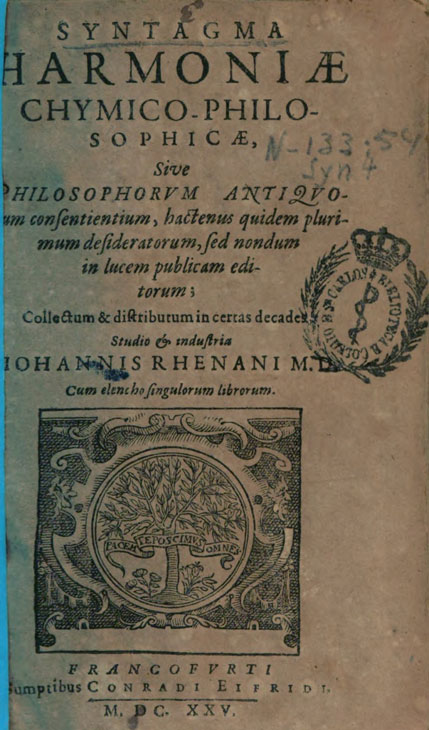
SYNTAGMA
OF CHYMICO-PHILOSOPHICAL
HARMONY,
Syntagma harmoniae chymico-philosophicae
or
the agreement of the ancient philosophers,
indeed long desired by very many up to now,
but not yet brought forth into public light;
Syntagma harmoniae chymico-philosophicae, sive philosophorum antiquorum consentientium ... nondum in lucem publicam editorum, collectum et distributum in certas decades, studio et industria Johannis Rhenani ...
collected and arranged into certain decades,
by the study and industry
of Johannes Rhenanus, M.D.
With an index of the individual books.
Pace reposcimus omnes
“We all seek again / require peace.”
FRANKFURT,
at the expense of Conrad Eifrid,
1625.
TO THE MOST ILLUSTRIOUS
AND MOST POWERFUL PRINCE AND LORD,
LORD AUGUSTUS, PRINCE OF ANHALT,
COUNT OF ASCANIA, LORD OF
SERVESTA AND BERNBURG, ETC.
To my most gracious Lord,
S. P. D.
It is indeed a bold thing, most illustrious and most powerful Prince, most gracious Lord, that I should dare to approach Your Highness with these few pages, and to salute you with this philosophical little gift. But if the matter is weighed in the fair balance of reason, my undertaking will appear excusable.
For it is known, indeed it is quite commonly known, that almost all who undertake to send some distinguished work into the public light are accustomed to inscribe and dedicate it to some great man, or friend, or other patron; and this chiefly for four reasons: namely, first, that by this very act they may devote not only their own names, but also the memory of the patron himself, as it were, to immortality; then, that they may obtain patronage against envious men, slanderers, and backbiting teeth, who always gnaw at what belongs to others, but do not see their own faults, and think nothing right unless they themselves have done it, and are accustomed to think right, it will be evident enough: further, so that the illustrious name prefixed to the work may stand like ivy upon a doorway, under whose sign, as though under that of some noble wine, it may be known, praised, and sold; and finally, that a public memorial may exist for the observance and gratitude owed for benefits received, and that the humanity and generosity of the patron may shine forth.
These very causes, I say, have also moved me to resolve to inscribe and dedicate to Your Highness this inscrutable chymico-philosophical harmony. For if I wished to recount such great and such varied benefits of Your Highness toward me, this dedicatory letter would almost grow into a volume.
Therefore, that I may show myself, at least in some part since I cannot do so wholly grateful toward Your Highness, I inscribe, assign, give, and dedicate to you this little gift, such as it is, humbly begging that you allow it to go forth under your patronage, and that against the hostile barkings and slanders of the pseudo-chymists you may be willing to defend, by whatever authority you possess, this harmony of our divine science.
I do not doubt that both the name of Your Highness, which even without this memorial is eternal, when inserted into the more illustrious libraries will be eternal for all ages, and that you will be counted without obliteration among the most learned men.
Farewell, most gracious Prince, and never cease to pursue me with your favor. I wrote this at Frankfurt, on the Kalends of May, in the year 1624.
your most observant client,
JOHANNES RHENANUS, M.D.
PREFACE TO THE READER
Here you have, benevolent reader, several decades of philosophical writers, who indeed discuss the philosophers’ stone so accurately, so elegantly, and so excellently, and who have left nothing at all in writing without cause; but because of their excellence, and the envy of those who kept them back, they have not until now been made public property.
But I, with much sweat and great expense, have desired and gladly wished to make these things, gathered together from various sources, common with you.
For I do not act with those who, puffed up with envy, are always afraid lest someone should come upon that incomparable treasure, for the acquisition of which they themselves dare not even move a foot; but, like rich men, they hide away in their own places the books of those who have philosophized excellently, as though someone, by merely looking at them for the first time, could learn from those philosophers the method of preparing the stone and as though it were not rather a gift of God, who bestows it upon whom He wills.
Farewell.
Note from translator:
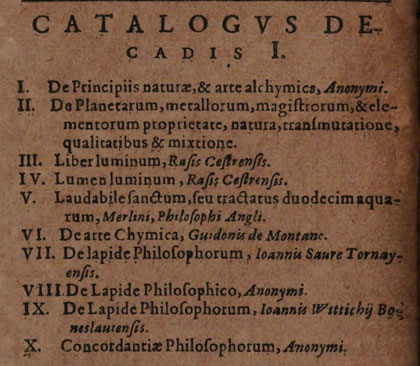
This book is compilation of multiple different books you will find each separately:
1. Book Concerning the Principles of Nature, and the Art of Alchemy, Anonymous
3. Liber Luminum, Rasis Cestrensis
4. The Light of Lights - Lumen Luminum, Rasis Cestrensis